How Can B2B Buyers Match Replacement Downlights and LED Panel Lights from Existing Specifications?
Use photos, labels, and measured dimensions to match replacement downlights and panel lights before requesting samples, tiered pricing, or production.
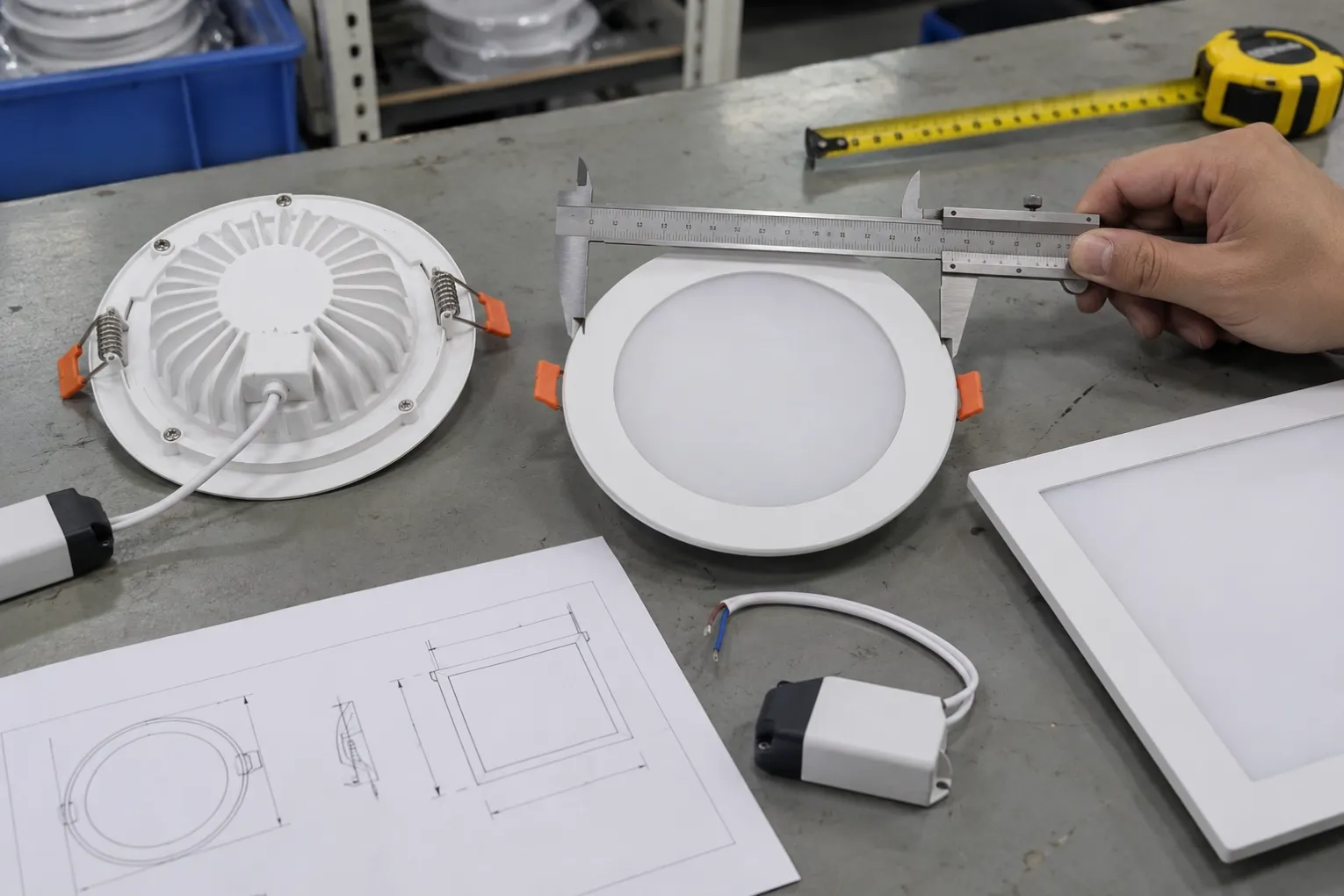
B2B buyers can obtain a reliable replacement recommendation from an existing fixture photo or specification sheet, but the supplier must know what “replacement” means for the project. Confirm whether the new light must keep the same opening, deliver similar light output, match the original appearance or meet a new target price. Then provide measured dimensions, electrical details, light requirements and expected quantity before requesting samples or production pricing.
What type of replacement does the project need?
Do not begin with wattage alone. First decide which parts of the original specification must remain unchanged.
| Replacement requirement | What it means |
|---|---|
| Exact replacement | Dimensions, installation, electrical specification and appearance must remain the same. |
| Installation-compatible replacement | The new light must fit the existing ceiling opening or grid, but other specifications may change. |
| Performance-equivalent replacement | The model may be different, but the required light output and visual result must be maintained. |
| Cost-controlled alternative | Some specifications may be adjusted to meet a target budget, subject to buyer approval. |
What should buyers send to the supplier?
1. Which photos are useful?
Send clear front, rear and side photos of the existing fixture. Include the driver, connector, mounting springs and product label. Place a ruler beside the light if a technical drawing is unavailable.
A catalogue image may identify the general design, but it cannot confirm the actual opening, depth, driver or installation method.
2. Which dimensions must be measured?
For a recessed round downlight, confirm the outer diameter, ceiling cut-out, overall depth and available ceiling space. For example, an outer diameter of Ø190mm and a cut-out of Ø175mm describe two different measurements. They should not be exchanged in an RFQ.
For a nominal 600×600mm panel light, confirm the actual fixture dimensions, thickness and ceiling-grid opening. Do not assume that every product described as “600×600” has identical physical dimensions.
3. Which electrical details are required?
Provide the rated wattage, input voltage, dimming requirement and any driver restrictions. If the original driver label is visible, include a clear photo. A replacement should not be approved only because its wattage matches the old product.
4. Which light specifications should be confirmed?
State the required CCT, approximate light output, colour-rendering requirement and beam distribution where relevant. Terms such as “neutral white” are not precise enough for production.
If the project requires 4500–5000K, clarify whether any value within that range is acceptable or whether one target CCT must be maintained across the downlights and panel lights.
What information should an RFQ include?
| RFQ field | Example information |
|---|---|
| Product type | Round recessed downlight or LED panel light |
| Existing model | Model number or product-label photo |
| Wattage | 15W, 24W, 30W or 40W |
| Outer dimensions | Measured fixture diameter or length × width |
| Cut-out or grid size | Measured ceiling opening |
| Overall depth | Fixture depth and available ceiling space |
| Input and control | Input voltage, non-dimmable or required dimming method |
| CCT | One target value or an approved range |
| Housing | Colour and required material |
| Quantity | Confirmed quantity or requested pricing levels |
| Destination | Country, postcode and required delivery date |
How should buyers compare the proposed replacement?
Ask the supplier for a side-by-side comparison rather than accepting a message stating that the model is “similar.” The comparison should clearly identify matched specifications, differences and points that still require confirmation.
| Comparison point | Buyer check |
|---|---|
| Physical fit | Outer size, opening, depth, springs and installation method |
| Electrical fit | Input voltage, driver and control requirement |
| Lighting result | CCT, output, beam and visible appearance |
| Construction | Housing, diffuser, heat-management structure and finish |
| Commercial terms | Quantity level, packaging, production schedule and delivery basis |
What if the final quantity is not confirmed?
Buyers can request pricing at several realistic quantity levels. Each level should use the same confirmed specification so the price comparison is meaningful.
For a mixed order, list the expected quantity of each model separately. Do not provide only one total quantity covering downlights and panel lights, because different models may have different materials, packaging and production requirements.
What should be approved before placing the order?
Before confirming production, review the final specification table, product photos, model number, quantity, CCT, dimensions, driver requirement, labels and packaging. If the proposed replacement differs from the original fixture, record the accepted difference in the PI or approved specification sheet.
A physical sample is recommended when installation compatibility, light appearance or CCT consistency cannot be confirmed from documents alone.
Frequently Asked Questions
Can a supplier identify a replacement from one product photo?
A photo can help identify the product family, but it normally cannot confirm the opening size, depth, driver or exact CCT. Measured dimensions and a label photo are also needed.
Is matching wattage enough to select a replacement?
No. Products with the same wattage may have different dimensions, output, beam distribution, drivers and installation methods.
Can a 40W panel replace a previous 48W panel?
Possibly, but the buyer should compare the actual light output, dimensions, driver, installation method and required lighting result before approval.
What if the original model is no longer available?
State which specifications cannot change and which differences are acceptable. The supplier can then recommend an installation-compatible or performance-equivalent alternative.
Should replacement samples be tested in the existing ceiling?
Yes, when practical. Testing the sample in the real opening or ceiling grid is the clearest way to confirm fit, installation and light appearance.
What should you send to DAYBREAK?
Send the existing fixture photos, product label, measured outer dimensions, cut-out or grid size, depth, wattage, input voltage, CCT, quantity range and destination. DAYBREAK can review the information and prepare a side-by-side specification comparison before quotation or sampling.
View commercial LED lighting products or submit your replacement-lighting requirements.
```