How Can Buyers Reduce Glare From LED Step Lights on Hotel Staircases?
Reduce staircase glare by checking source visibility, beam direction, mounting position, and surface reflections with an installed sample before bulk approval.
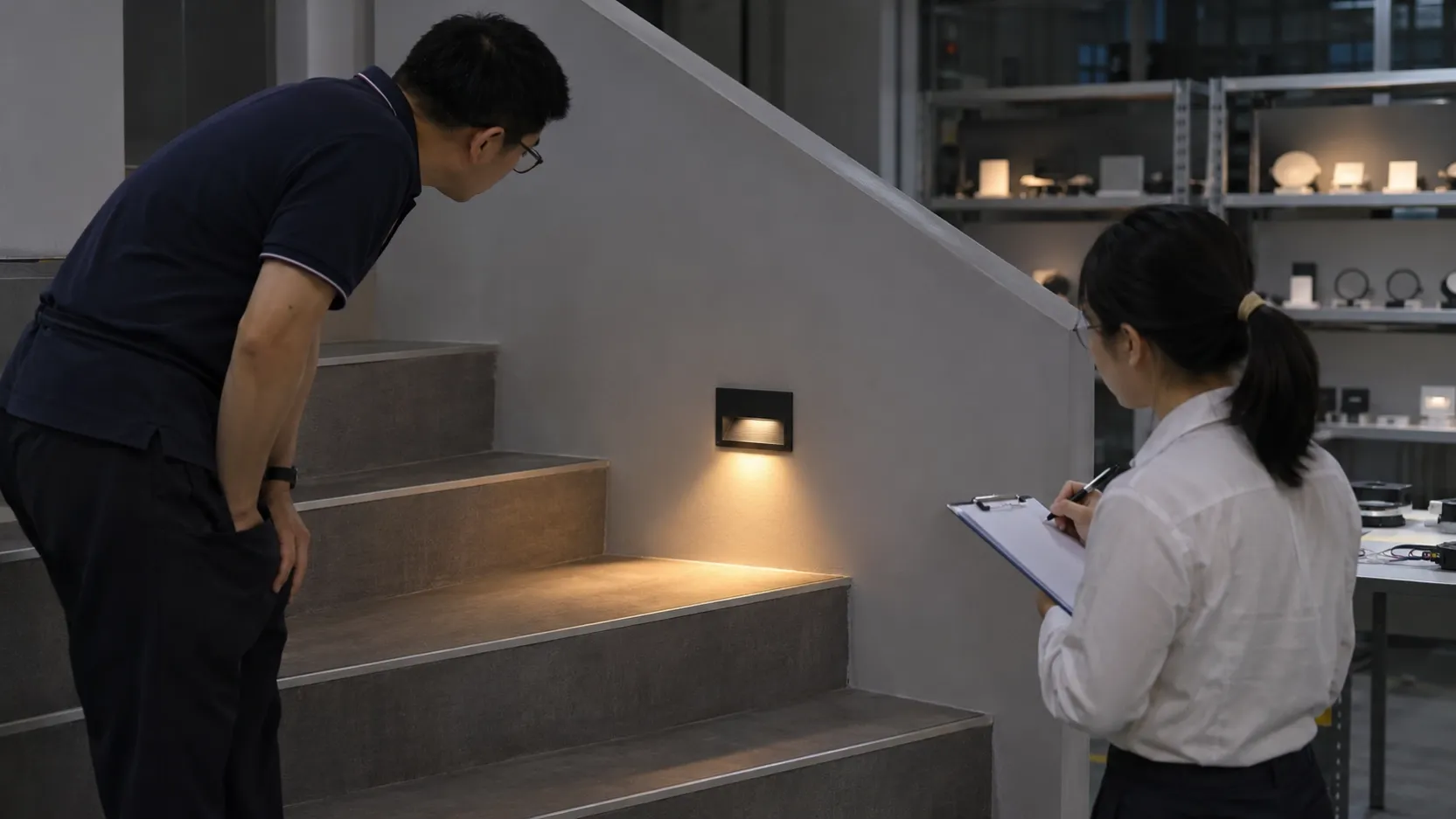
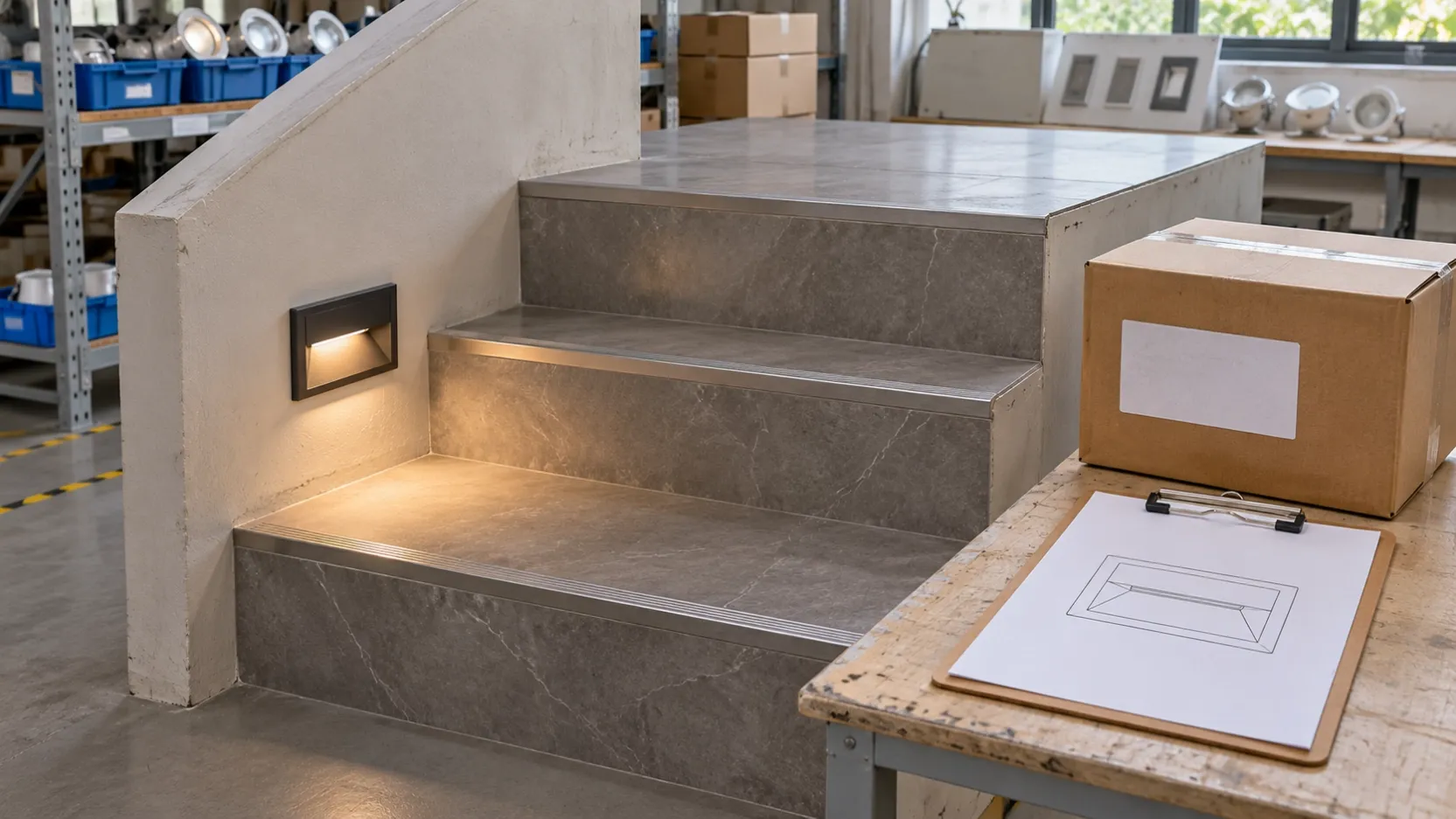
A hotel step light should help guests recognise the tread and change of level without becoming the brightest object in their view. Buyers should therefore judge the installed effect, not select the product from wattage or beam angle alone. The faceplate opening, source visibility, mounting position, wall finish, tread material and background brightness all affect whether the light feels comfortable.
Before approving a bulk order, install one sample at the proposed position and view it while walking both up and down the staircase. Check where the light lands, whether the source can be seen directly and whether nearby surfaces create distracting reflections.
Why does low wattage not automatically mean low glare?
Wattage describes electrical power. It does not tell the buyer how bright the light source will appear from a particular position.
A compact 1W light can still feel uncomfortable if the LED or a bright optical surface is directly visible from the top of the staircase. A higher-power light may feel less intrusive when its source is properly shielded and its output is directed onto the walking surface.
The useful question is not simply “How many watts is the light?” It is “What will a guest see when approaching this fitting from above, below and across the landing?”
Does a narrow beam always reduce glare?
No. A narrow beam can keep more light away from surrounding walls, but it may also create a small, high-contrast bright patch. If the source remains visible, concentrating the light does not solve the discomfort problem.
A wider beam can illuminate more of the tread and nearby floor, but it may also reach the observer’s line of sight if the faceplate does not provide enough shielding. Neither a narrow nor a wide beam is automatically better. The beam must suit the mounting position and the area that needs to be seen.
DAYBREAK quotation information lists different beam ranges for different faceplate series. Some series cover approximately 10° to 90°, while another begins at approximately 20° and extends to 90°. These are series ranges, not proof that every faceplate produces every angle. The exact relationship between a particular opening and beam angle must be confirmed for the model being quoted.
How does the faceplate opening affect visual comfort?
The faceplate controls more than appearance. Its opening determines how much of the optical system is exposed and which directions the light can leave the fitting.
A small downward opening may conceal the source from someone standing above the light while directing the beam onto the tread. A larger or more open faceplate may spread light across a wider area, but the source may become visible from more viewing positions.
The faceplate must also be fitted completely and in the approved orientation. If it is loose, tilted or installed upside down, the beam direction and source shielding can differ from the approved sample. This can create a glare complaint even when the correct model was supplied.
Why does mounting position change the result?
The same light can appear comfortable at one position and distracting at another. Moving it changes the relationship between the opening, the tread and the observer’s eyes.
A light installed too high may project farther into the field of view and become visible from below. A light installed very close to the tread may produce a concentrated bright patch without helping guests read the next part of the staircase. The exact result depends on the product and stair geometry, so a universal mounting height should not be copied from another project.
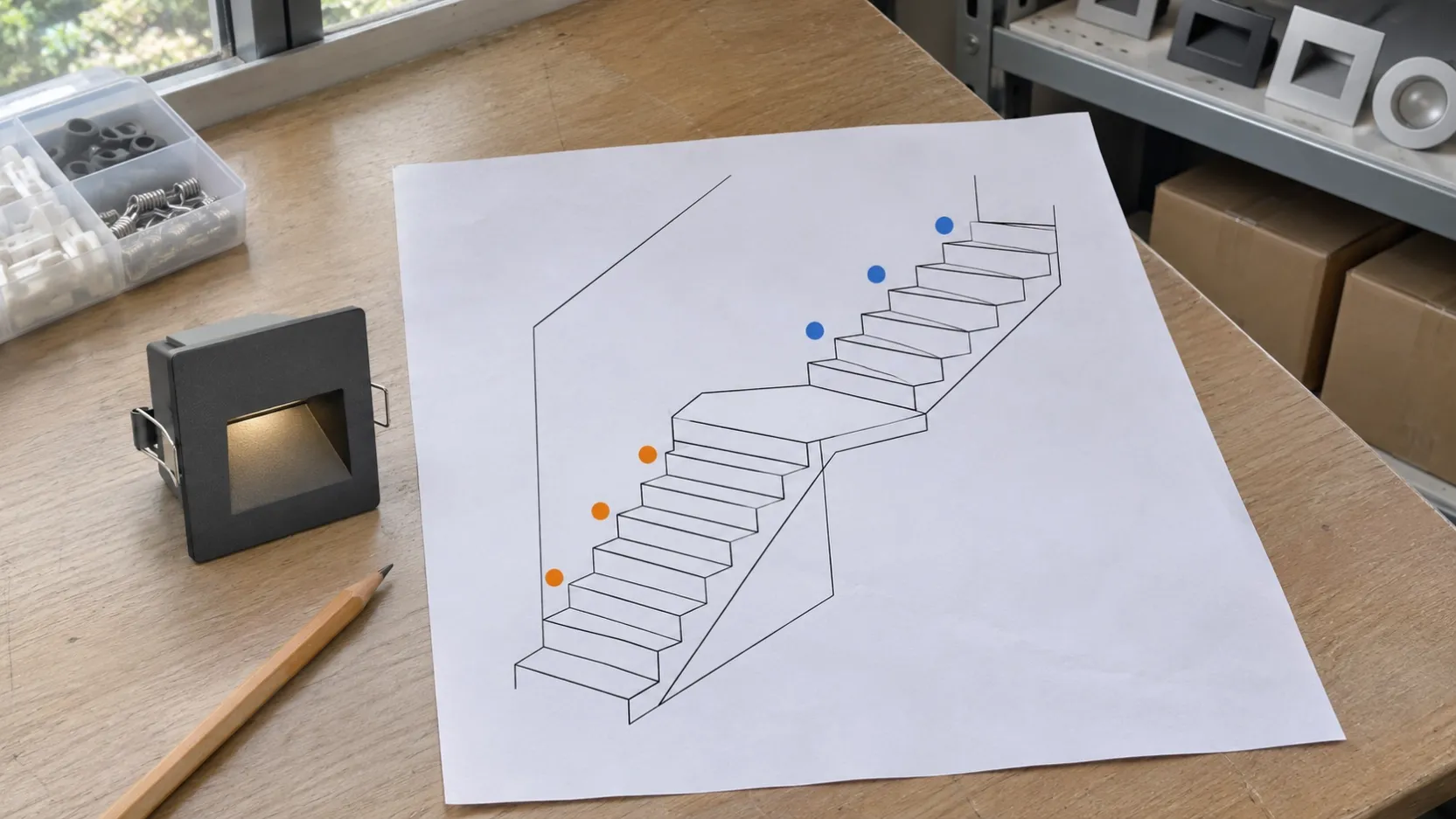
Review the proposed position on the staircase elevation and measure it from the finished tread, not from unfinished concrete. The test sample should use the same faceplate orientation planned for the final installation.
How do wall and tread finishes affect perceived glare?
Surface colour and texture change the contrast around the light. A light-coloured matte wall may spread more reflected light around the fitting, making the transition between the beam and its surroundings appear softer. A dark wall can absorb more light and make the illuminated opening or light patch appear more prominent by comparison.
Glossy stone, polished metal, glass and glazed tiles may create a secondary bright reflection. The reflected image can be uncomfortable even when the source itself is shielded.
This does not mean that one wall colour or material is always better. It means that a sample tested on a white factory wall may not represent the final result on black stone, timber veneer or polished tile. When possible, test the light against a material sample that is close to the project finish.
Should buyers request a UGR value for a step light?
A UGR number should not be requested or published without the necessary photometric information and installation conditions. Discomfort glare depends on the source luminance, background, observer position and viewing direction. It is not determined by the product name or wattage alone.
The CIE glare evaluation method recognises the importance of the observer’s position and direction of view. For a low-level staircase fitting, the actual approach from above, below and across a landing is therefore important.
If the selected model does not have suitable glare data or an IES file, do not invent a UGR result. Use a full-size installed sample to evaluate source visibility, beam placement and reflections, and let the responsible lighting designer decide whether additional calculation or measurement is required.
How should a hotel step-light sample be tested?
Do not evaluate the sample only on a table or while holding it against the wall. Install it in a mock-up or representative wall section using the proposed height, orientation and recess depth.
View the sample from the bottom of the flight while looking upward. Then stand at the top and look down toward the fitting. Walk across the landing and approach the staircase from the side. If the staircase turns, repeat the observation from the new direction.
During the test, answer four practical questions:
- Can the guest identify the edge and surface of the tread?
- Is the LED or another high-brightness optical surface directly visible?
- Does the beam create a distracting bright patch or reflection?
- Does the result remain comfortable from both directions of travel?
Test under lighting conditions similar to the hotel’s intended night operation. A brightly lit factory or office can hide glare that becomes noticeable when the staircase background is darker.
A mobile-phone photograph is useful for recording the approved arrangement, but it should not replace direct observation. Automatic exposure and image processing can make the light appear softer or harsher than it looks to the eye.
What should be recorded after the sample is approved?
Keep the exact model, wattage, CCT, faceplate code, finish and installation orientation with the approval record. Add the mounting height measured from the finished tread, wall and tread materials, and photographs taken from above, below and across the landing.
If the step light includes a sensor, record the sensor version separately. Glare approval and sensor approval answer different questions. The light may have a comfortable beam but still require further testing of detection range and delay time.
The approved sample should remain available for comparison with the production order. Changing the faceplate opening, optical component or installation orientation later can change the visible result even if the wattage remains the same.
How can a 1W indoor step light be evaluated?
DAYBREAK’s DB-LSL-IP20-01S is a 1W recessed step light for dry indoor stairs and corridors. The series uses an 86 × 86 mm faceplate, an 80 × 80 × H50 mm opening and a 90° downward light distribution.
These specifications help the buyer check wall compatibility and understand the intended direction of light. They do not prove that the fitting will be glare-free at every height or on every staircase. The final position and visible effect should still be approved using the actual faceplate, wall finish and stair geometry.
What should buyers send before requesting samples?
Send the staircase elevation, stair width, tread and riser dimensions, proposed mounting height, wall and tread finishes, required CCT, control method and quantity. Include photographs or renderings showing how guests enter the staircase and where the landings turn.
DAYBREAK can use this information to confirm available product and faceplate options, installation dimensions and the sample configuration. The project team can then evaluate the installed result before approving the complete order.
Frequently Asked Questions
Is a 1W step light always more comfortable than a 3W model?
No. Comfort depends on source visibility, optical design, mounting position, beam placement and the surrounding surfaces. Wattage alone cannot predict glare.
Does a 10° beam mean the light is anti-glare?
No. A narrow beam describes light distribution, not guaranteed visual comfort. The source may still be visible, and a concentrated beam may create a high-contrast light patch.
Can warm white light eliminate glare?
No. CCT changes the appearance of the light but does not remove excessive source brightness or direct visibility. A warm light can still be uncomfortable if the optical and installation conditions are unsuitable.
Should the step-light beam reach the centre of the staircase?
That depends on the stair width, wall position and required visual guidance. The beam should make the walking surface and changes of level readable without directing unnecessary light toward the observer.
When should the glare sample be approved?
Approve it before all wall openings and bulk production are finalised. The test should use the intended faceplate, mounting orientation and a representative wall or finish sample.