110V Supply? How to Check an LED Light Will Work Before You Order
Most of our lights accept 85–265V, so the same fitting works on 110V and 220V. How to read the input-voltage line and check your model before you order.
If your site runs on 110V, the question is not "do you make a 110V version?" Most of our lights accept anything from 85V to 265V, so the same fitting works on a 110V supply and a 220V supply. The check that matters is the input-voltage range printed on the specification sheet for the exact model you are ordering.
What "AC85–265V" on a spec sheet means
It means the light has a wide-voltage driver: the driver takes whatever the wall supply gives it, anywhere from 85 to 265 volts, and delivers the power the LEDs need. One fitting covers the supplies used in nearly every country — 110V and 120V in the Americas and the Caribbean, 220V and 240V in Europe, Asia and Australia — with no transformer and no special version to order.
Ranges do differ by model, so read the line for your model, not the range in general. Some of our fittings are rated AC100–265V instead of AC85–265V. A 110V supply still sits inside that range, but the number on your model's sheet is the one that counts — never assume one model's rating applies to another.
What goes wrong with the wrong voltage
A fitting built for 220V only, connected to 110V, may glow dimly, flicker, or not start at all. A fitting built for 110V only, connected to 220V, can have its driver damaged the moment it is switched on. Both failures are avoidable, and both are expensive to discover after the lights are installed — the check takes thirty seconds before ordering.
The check before you order
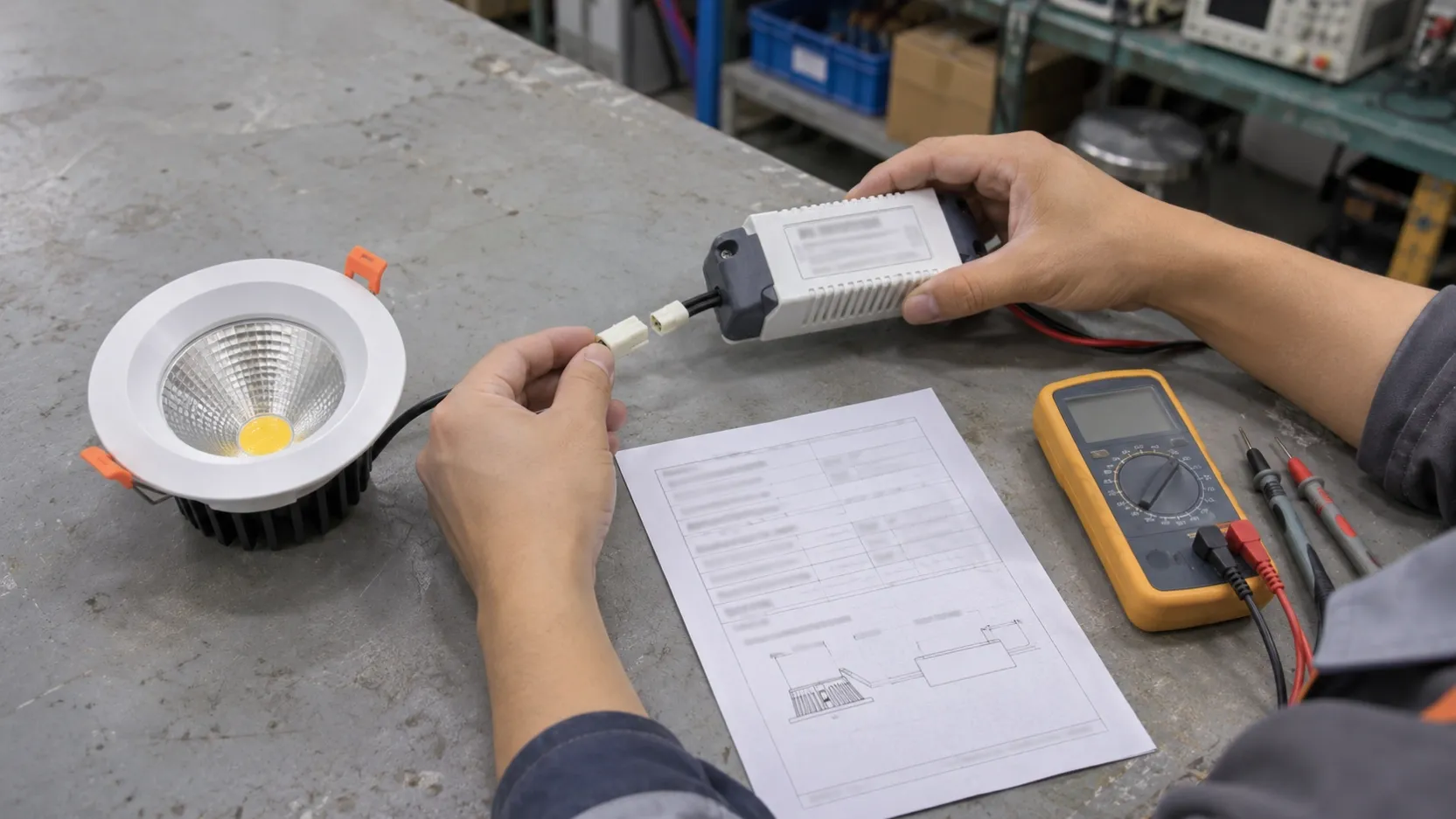
Read the input-voltage line on the specification sheet. It is usually listed as "Input Voltage" in the specification table. If the sheet does not show it, ask the supplier for it in writing — do not guess from the plug type or the country the fitting was designed for.
Confirm your local supply sits inside the range. Your electrician or the building's electrical drawings will give the exact figure. Supplies vary even within one region: the Caribbean, for example, has islands on 110V and islands on 220V.
State your supply voltage in writing on the order. That way the factory ships the driver that matches your site, and there is a written record if anything arrives wrong.
Test the sample on your own supply. A sample that works on the supplier's bench proves nothing about your site. Plug it in where it will actually be used, at the voltage it will actually run on.
FAQ
Do I need a transformer for a 110V supply?
No, not if the fitting's input-voltage range covers 110V. The driver inside the fitting does the conversion. A transformer only adds a point of failure.
Will the light be dimmer on 110V than on 220V?
No. A wide-voltage driver is designed to deliver the same output across its whole range, so brightness does not depend on whether your supply is 110V or 220V. Brightness is set by the fitting's wattage, not by the mains voltage.
What about 100V in Japan or 120V in the US?
Both sit inside an 85–265V range. As always, confirm the exact range on your model's specification sheet before ordering.
Our 7W–40W 3-CCT selectable recessed downlight is rated AC85–265V, so it runs on 110V and 220V supplies alike. All our LED downlights and step lights are CE and RoHS certified, with a 3-year warranty — a quality problem within the warranty period is replaced free of charge. Planning a project on a 110V supply? Send your drawings or site photos to sophia@daybreaklight.com, tell us your local voltage, and we will confirm the matching models in writing before you order.