What Should Commercial Buyers Check Before Specifying Anti-Glare Recessed Downlights?
Learn how to evaluate anti-glare recessed downlights using shielding, photometric data and room conditions instead of relying on a single UGR claim.
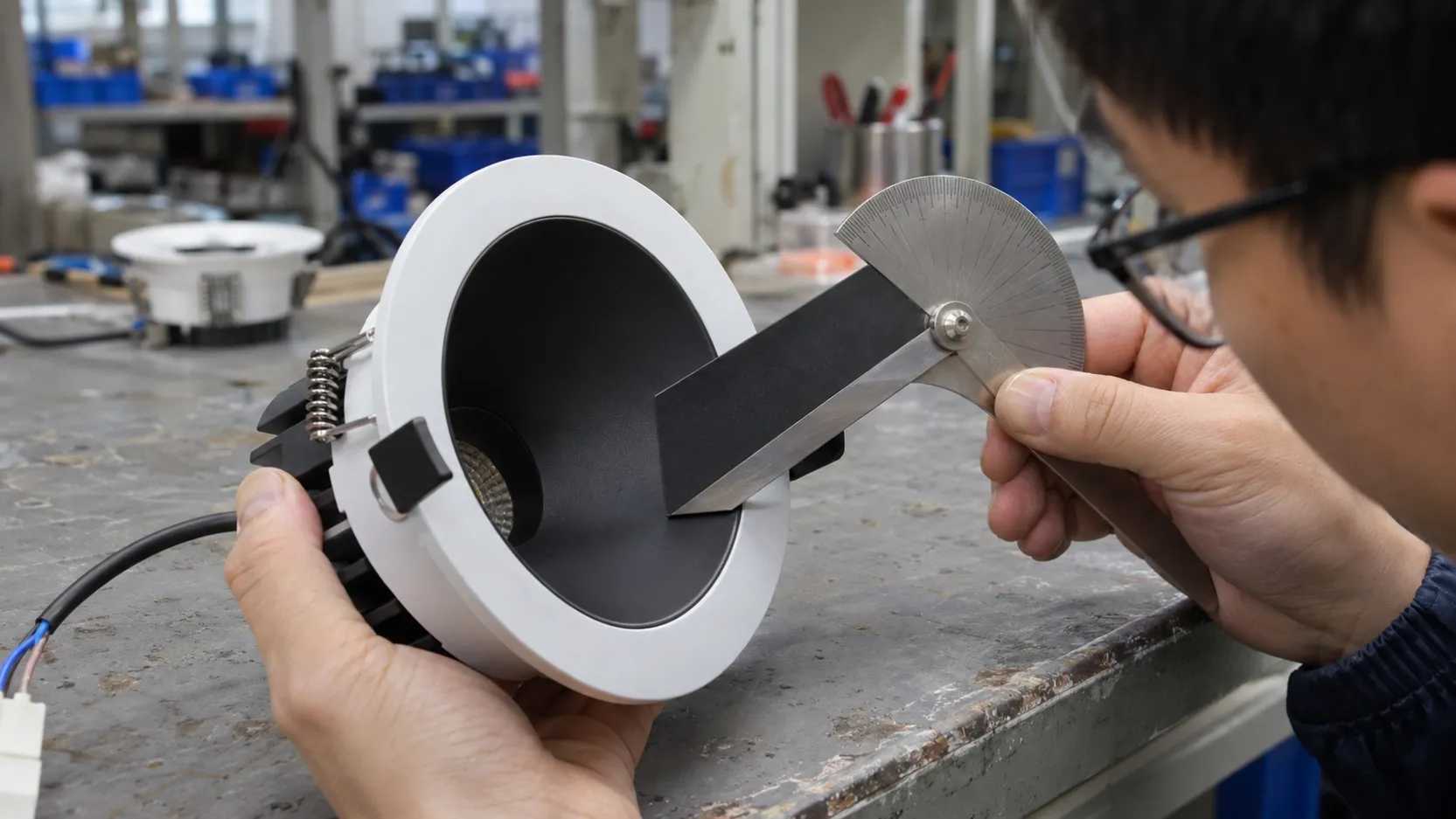
Commercial buyers should not approve an “anti-glare” recessed downlight from its appearance or a single UGR claim. First check how well the light source is shielded, then ask for photometric data and evaluate the proposed fitting in the actual room layout.
A deep aperture, dark baffle or narrow beam may reduce direct view of the LED from some angles, but none of these features proves that a completed office, hotel or retail project will meet a particular glare limit. Glare depends on both the luminaire and the conditions in which it is installed.
What does “anti-glare” actually mean?
“Anti-glare” is commonly used to describe a luminaire designed to reduce uncomfortable brightness in the viewer's field of vision. It is not, by itself, a complete technical specification.
Two recessed downlights can both be described as anti-glare while using very different methods. One may place the LED deeply inside the housing. Another may use a black baffle, reflector, lens or honeycomb louvre. A third may control high-angle light through its optical distribution.
These features can be useful, but the buyer still needs to know what happens from the expected viewing positions. A downlight may appear comfortable when viewed directly from below while exposing a bright LED or reflector when seen from across the room.
The useful purchasing question is therefore not “Is this an anti-glare downlight?” It is “What prevents the bright source from entering the user's normal line of sight, and what evidence is available for the proposed installation?”
Which physical features can help reduce direct glare?
How does a deep-recessed aperture help?
Moving the LED source farther inside the luminaire can prevent it from being seen at some oblique viewing angles. The trim, reflector and internal walls act as physical shielding between the source and the observer.
Depth alone is not enough. The result also depends on the aperture diameter, reflector shape, LED position and the angle from which people see the fitting. A large bright reflector can remain visible even when the LED chip itself is hidden.
What do baffles and dark internal finishes do?
A baffle blocks or redirects high-angle light. A dark internal finish can reduce distracting reflections inside the aperture. These details may improve visual comfort, especially when the luminaire is seen from the side rather than directly underneath.
The buyer should inspect an unpowered sample as well as an illuminated sample. Looking into the aperture from several realistic angles makes it easier to see whether the LED, lens or bright reflector becomes exposed.
Does a narrower beam automatically mean less glare?
No. A controlled beam may reduce unwanted high-angle light, but a narrow beam can also create high luminance and strong contrast if it is used in the wrong position. Beam angle should be selected for the lighting task, mounting height and spacing—not used as a substitute for glare evaluation.
Why is UGR not a fixed result for every project?
Unified Glare Rating, or UGR, is used to evaluate discomfort glare in an indoor lighting installation. Its calculation considers the luminance and apparent size of the luminaires, their position relative to the observer and the background luminance of the room.
This means the result can change when the room dimensions, mounting height, surface reflectance, luminaire spacing, observer position or viewing direction changes. The same luminaire can therefore produce different calculated UGR results in different rooms.
The CIE 117 method specifically considers observer position and viewing direction. The CIE 190 guidance explains how manufacturers can prepare UGR tables using defined reference-room conditions.
A UGR table is useful for comparing products under the stated assumptions, but the number should not be presented as a result that applies automatically to every installation.
What does UGR 19 mean for an office project?
EN 12464-1:2021 gives a limiting UGR value of 19 for office tasks such as writing, typing, reading and data processing. It also specifies other requirements, including maintained illuminance, uniformity and colour rendering.
This does not mean that every downlight advertised as “UGR<19” will make every office compliant. The project still needs a suitable layout and a calculation based on the room.
Office glare is particularly sensitive to viewing direction. A person looking across a room toward luminaires may experience a different condition from someone seated directly below them. Screen position, desk orientation and luminaire spacing therefore matter as much as the product label.
Different tasks also have different glare limits. Technical drawing requires tighter control than general retail circulation, while corridors can accept a different limit from desk work. Buyers should identify the actual task before asking a supplier for “UGR 19 lighting.”
Why can a catalogue UGR value be misleading?
A catalogue may show one UGR value without explaining the room dimensions, reflectance values, installation pattern or viewing direction used to produce it. In that case, the buyer cannot tell whether the number represents a standard table, one selected cell from that table or a calculation for a particular project.
The standard tabular method also has limitations. Adjustable spotlights, very small luminous surfaces, asymmetric distributions and irregular layouts may require more careful evaluation instead of relying on one catalogue figure.
This is especially relevant to small-aperture accent downlights. A small opening can provide useful shielding, but the high luminance of the visible aperture and the actual direction of the beam still need to be considered.
What should the buyer ask the supplier to provide?
The buyer should begin by sending the room information instead of asking only for an anti-glare model. Useful information includes the room dimensions, ceiling height, working-plane height, luminaire positions, preferred beam angle, target illuminance and normal viewing directions.
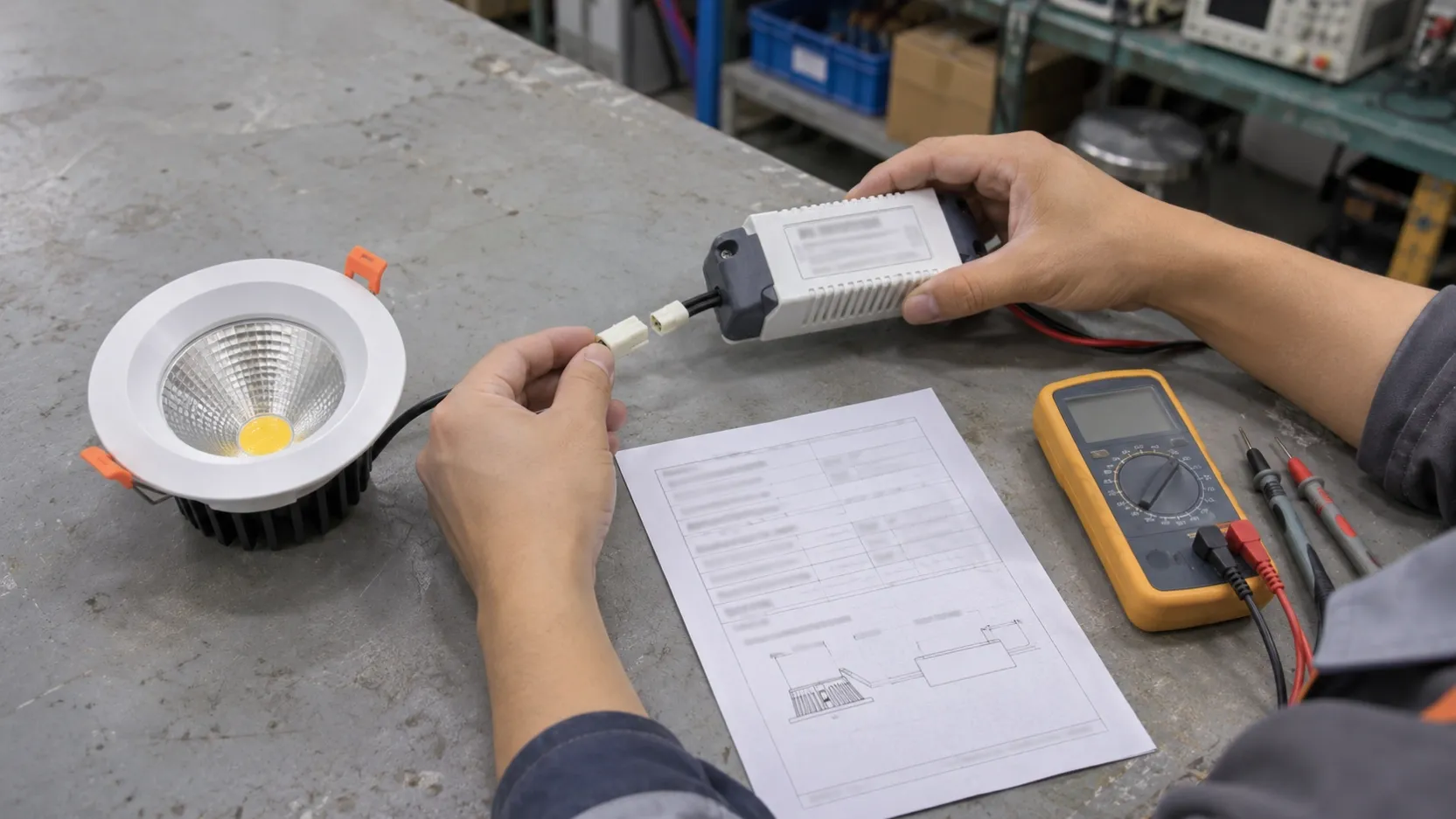
The supplier can then confirm what evidence is available for the proposed model. Depending on the product and project, this may include an IES or LDT photometric file, a UGR table with its reference conditions, a luminous-intensity distribution, dimensions of the visible aperture and information about the reflector, baffle or shielding structure.
If the supplier provides only a statement such as “UGR<19,” ask which conditions produced that value. A technically useful answer should identify the assumptions behind the result.
If no photometric file or UGR data is available, the product should not be presented as a verified UGR solution. It may still be reviewed as a deep-recessed or visually shielded downlight, but the limitation must be clear before the customer relies on it for a standards-based project.
How should a sample be reviewed before a bulk order?
A sample review cannot replace a complete lighting calculation, but it can reveal problems that are difficult to understand from a product photograph.
Install the sample at a height close to the intended project condition. View it from normal seated and standing positions rather than only from directly below. Check whether the LED, lens or bright reflector becomes visible when walking through the room or looking across a desk.
The review should also include the required beam angle, CCT and output. A low-output sample may appear comfortable simply because it is dimmer than the final project version. The production configuration should therefore match the approved sample.
Record the exact model, wattage, beam angle, CCT, driver and optical components used in the sample. These details should be repeated on the quotation and purchase order so that the bulk production does not use a different reflector or LED position.
Can dimming solve a glare problem?
Lowering the output may reduce the luminance of the source and make a space feel more comfortable. However, dimming does not correct an exposed LED, inadequate shielding, poor luminaire placement or an unsuitable viewing geometry.
If the project must dim the lights to avoid discomfort during normal use, the product selection or layout may need to be reconsidered. Dimming should support the lighting scene and energy strategy, not compensate for a basic optical problem.
How does the DAYBREAK DB-DL6A fit this discussion?
The DAYBREAK DB-DL6A recessed COB downlight uses a deep-recessed small aperture and a focused 24° beam. The product page lists 5W to 12W options and cut-outs from 45mm to 75mm for hotel and retail accent-lighting applications.
These physical features can help shield the light source from some viewing angles, but the current product page does not publish a specific UGR result, shielding angle or photometric file. DAYBREAK should therefore not describe DB-DL6A as a verified UGR 19 office downlight without additional model-specific evidence.
A buyer considering this model should send the application, ceiling height, quantity, required wattage, CCT and layout. DAYBREAK can review whether the deep-recessed focused-beam design suits the intended accent-lighting task and confirm which technical information is available before sampling.
What is the safest way to specify an anti-glare downlight?
Start with the people and the room, not the product label. Identify where users will sit, stand and look. Define the relevant glare limit and illuminance requirement for the task. Then ask for a luminaire with suitable shielding, optical control and photometric data.
Use the supplier's UGR table as reference information, not as a universal project result. Complete a room-based calculation when compliance matters, and review a representative sample from realistic viewing positions before approving the bulk order.
This process gives the buyer a defensible specification. It also prevents “anti-glare” from becoming an unverified marketing description that is only questioned after the ceiling has been completed.
Questions Commercial Buyers Commonly Ask
Does a deep-recessed downlight automatically meet UGR 19?
No. A deep aperture may improve shielding, but the project UGR also depends on photometric distribution, room conditions, luminaire layout and observer position.
Is the UGR value printed in a catalogue enough for project approval?
No. Ask for the UGR table or calculation conditions and confirm whether they match the proposed room. A single catalogue number does not describe every installation.
What should I send when requesting an anti-glare downlight?
Send the application, room dimensions, ceiling height, target illuminance, layout, viewing direction, required quantity, CCT and any glare limit stated by the designer.
Can a sample prove that an office meets UGR 19?
A sample can help assess visible shielding and comfort from realistic positions, but standards compliance normally requires suitable photometric data and a room-based lighting calculation.