How Should B2B Buyers Specify Ra>80 or Ra>90 for Commercial Lighting Projects?
Learn when Ra>90 adds real value, when Ra>80 is sufficient, and how to verify colour rendering before approving a commercial lighting order.
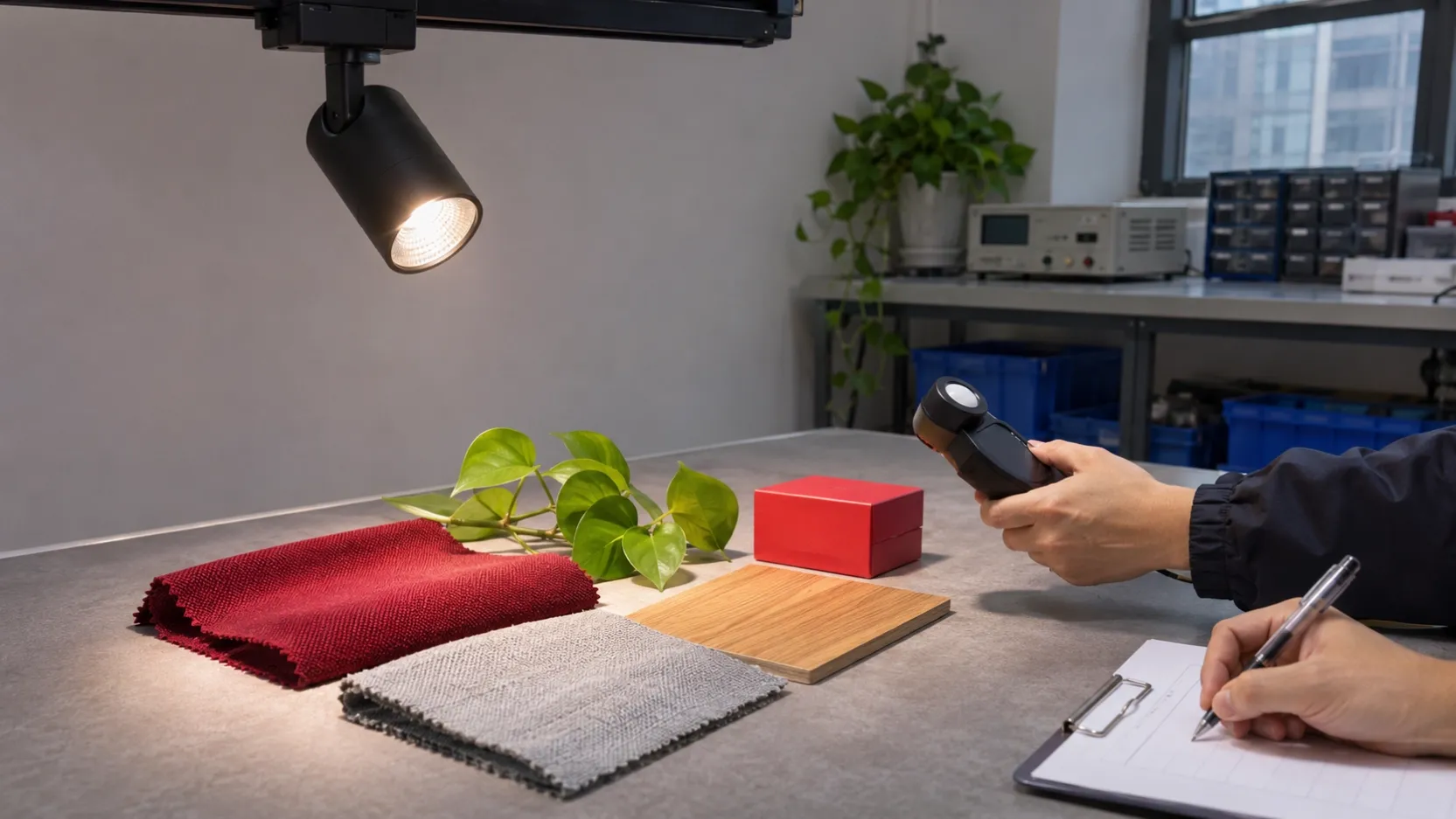
Ra>90 is worth specifying when the light directly affects how customers judge merchandise, food, finishes, artwork or skin tones. For general corridors, storage rooms and other areas where detailed colour judgement is not part of the task, Ra>80 is often a practical starting point.
The decision should not be based on the building type alone. A retail store may need Ra>90 above its merchandise but not in its stockroom. A hotel may need better colour rendering at reception, in guestrooms and around artwork, while its service corridors have a different requirement. Specifying Ra>90 everywhere can increase cost without improving every area. Specifying Ra>80 everywhere can save money initially but leave important materials looking different from the designer's intention.
What decision is the buyer actually making?
Imagine that a buyer receives two quotations for a clothing store. One track light is listed as Ra>80 and offers suitable output at a lower cost. The other is Ra>90 and costs more. Looking only at the two numbers does not tell the buyer which one belongs in the project.
The useful question is: what will people need to judge under this light?
If the light is used over clothing, cosmetics, coloured packaging, wood finishes or other merchandise, small colour differences can influence how the product is perceived. A higher colour-fidelity requirement can be justified because colour presentation is part of the commercial purpose of the lighting.
If the same light is only providing general visibility in a circulation or service area, the additional cost of Ra>90 may offer little practical benefit. The correct specification follows the visual task, not a rule that every commercial project must use the same Ra value.
Why does Ra not tell the complete colour story?
Ra is the average result from eight standard colour samples, known as R1 to R8. It is useful for describing general colour fidelity, but it does not include the saturated red sample R9.
This matters because two light sources can carry the same Ra rating while rendering deep red materials differently. Red fabrics, food, warm wood and some skin tones can therefore appear different even when both product sheets state Ra>90.
R9 adds useful information about saturated red, but it should not be treated as a complete quality score on its own. The final appearance is also affected by the complete spectrum, colour temperature, illumination level, surrounding finishes and the material being viewed.
The U.S. Department of Energy notes that CRI has limitations when predicting saturated-red fidelity and that R9 is often used as a supplementary value. The Illuminating Engineering Society also advises against using one average colour-fidelity number as a universal specification for every application.
Why should the selected CCT be included in the Ra confirmation?
A catalogue may list several colour temperatures beside one general Ra statement. Buyers should not automatically assume that every CCT, wattage and LED configuration has an identical measured result.
A 3000K light and a 4000K light have different white appearances and can use different spectral combinations. Even when both meet the same minimum Ra requirement, the actual appearance of red fabric, timber, stone or packaging may not be identical.
This is why an enquiry should not simply say “high CRI required.” It should identify the model, wattage and CCT being ordered. If the project has an important red-rendering requirement, the buyer should also ask whether R9 data or a corresponding colour test report is available for that configuration.
When the supplier cannot provide configuration-specific R9 or test data, that information should not be invented or inferred from a general catalogue statement. The buyer can instead treat the sample review as an essential part of approval.
How can a buyer verify colour rendering before a bulk order?
The most useful test is not looking at the light by itself. It is looking at the materials the project needs the light to reveal.
For a fashion store, place the sample above the actual fabrics, including red, neutral and dark colours. For a hotel, review skin tones, timber, upholstery and artwork. For a restaurant, examine the food presentation, table finishes and warm decorative materials. The comparison should use the intended CCT and similar illumination levels; otherwise, the buyer may be comparing colour temperature or brightness instead of colour rendering.
A smartphone photograph can document the review, but it should not be the only basis for approval because the phone may automatically change exposure, white balance and colour saturation. The decision should be made by viewing the materials directly and recording the exact sample configuration that was accepted.
Once the sample is approved, the model, wattage, CCT and minimum Ra requirement should appear on the quotation and purchase order. If R9 or another colour metric is part of the decision, that requirement should also be written into the order rather than left in an email conversation.
What should the buyer send with the enquiry?
A supplier can give a more useful answer when the enquiry explains what the light will illuminate. Instead of requesting “a high-CRI track light,” the buyer can send the application, material type, required CCT, wattage range, quantity and any client specification already received.
For example:
“The track lights will illuminate red, black and neutral clothing in a retail store. We require 3000K and a minimum Ra>90. Please confirm the Ra specification for the proposed model and advise whether R9 data or a corresponding test report is available. We would like to review one sample before confirming the project quantity.”
This gives the supplier enough information to review the correct configuration. It also separates a verified product requirement from a general sales description.
How does this apply to DAYBREAK's TL-1 track light?
The DAYBREAK TL-1 zoomable COB track light product page currently lists Ra>90, 12W, 20W and 30W options, a 15–60° adjustable beam and 3000K, 4000K and 6000K colour temperatures.
The page does not currently publish an R9 value or separate colour-rendering results for each CCT. We should therefore not claim that every CCT has an identical R9 or individually verified Ra result without checking the actual configuration.
A buyer considering TL-1 should send the required power, CCT, quantity, track system and materials being illuminated. DAYBREAK can then confirm the proposed configuration and advise which supporting information is available before the customer approves a sample or places a bulk order.
What is the practical specification?
Use Ra>80 as a practical starting point where general visibility is the main purpose. Consider Ra>90 where colour presentation affects the customer experience, design approval or sale of the product. Add an R9 requirement when saturated-red performance has specific importance.
Most importantly, connect the requirement to the exact model, wattage and CCT being purchased. Review the real project materials under a representative sample, record the approved configuration and repeat those details in the final order.
That process gives the buyer more protection than choosing the largest Ra number in a catalogue. It also gives the supplier a clear and verifiable target for sampling and production.