24° or 60° Beam Angle: Which Fits Your Commercial Project?
At 3 m, a 24° beam makes a 1.3 m pool of light; a 60° beam makes 3.5 m. Choose by mounting height, target size and contrast — not by the fixture alone.
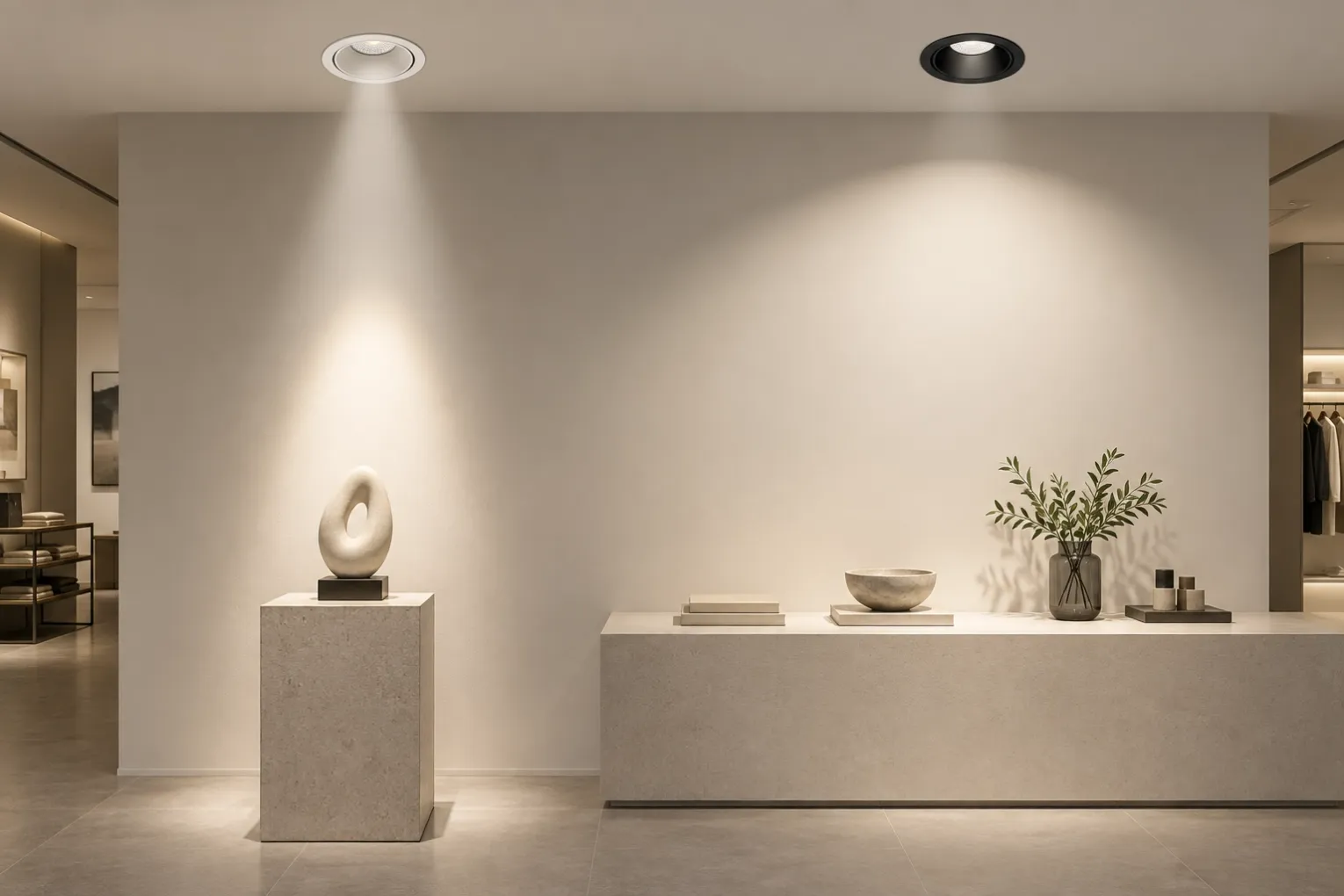
For most commercial interiors, 24° suits focused accent lighting while 60° suits broader general coverage. The right choice depends on mounting height, target size and the contrast you need — not on the fixture alone.
Key facts about recessed COB spotlight beam angles
- 24° is an accent beam — it isolates a product, artwork or feature wall.
- 60° is a wash beam — it covers a broader area with softer edges.
- Beam diameter grows with distance: at 3 m, 24° covers roughly 1.3 m, 60° roughly 3.5 m.
- Longer mounting distances need a photometric review to keep intensity on the target.
- One project often needs both — accent over displays, wash over circulation.
When should you use 24°?
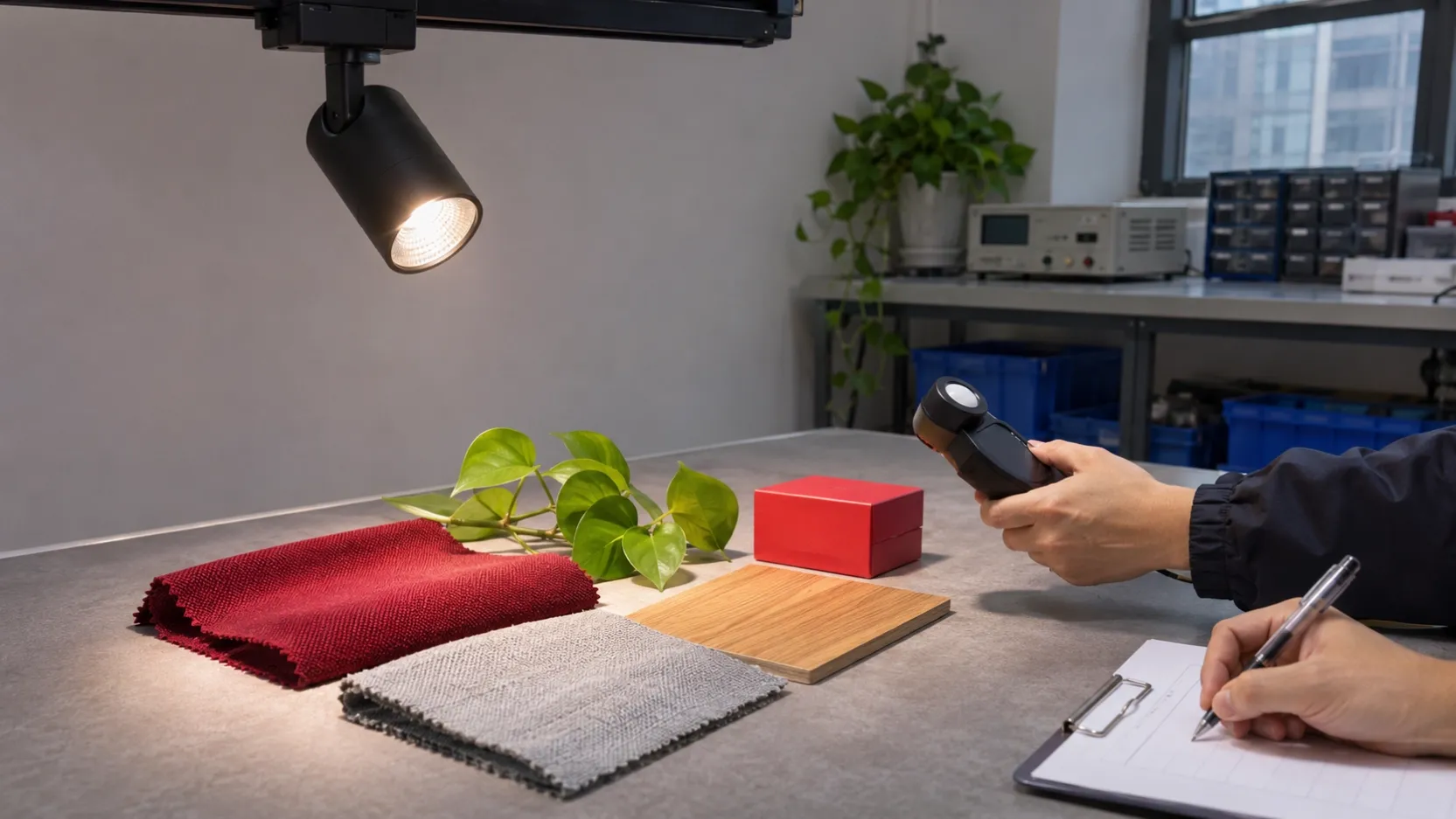
A 24° beam concentrates light into a defined pool with a visible edge. That makes it the standard choice for retail displays, gallery walls, reception features and dining tables where the object should stand out from its surroundings.
It also controls spill. In a restaurant or gallery, a narrow beam keeps light off neighbouring surfaces and preserves the contrast that makes the display read as deliberate.
| Application | Why 24° |
|---|---|
| Retail product display | Isolates merchandise, creates contrast |
| Gallery and artwork | Defines the viewing field |
| Reception and feature wall | Accent without flooding the room |
| Dining and hospitality tables | Warm pool of light at the table |
Why choose 60°?
A 60° beam produces a wide, soft-edged pool. It is the practical choice for general lighting in offices, retail aisles, corridors and any space where even coverage matters more than contrast.
A wider beam increases the nominal covered area at a given distance, but does not compensate for the reduction in illuminance as distance increases. For a high ceiling, compare the required target size and illuminance with the selected model’s intensity distribution before choosing 24° or 60°.
| Application | Why 60° |
|---|---|
| Office general lighting | Even illuminance across desks |
| Retail aisles | Continuous coverage, fewer dark gaps |
| Corridors | Comfortable, low-contrast lighting |
| High ceilings | Check coverage and illuminance with model-specific photometry |
Can one project use both?
Yes, and most commercial projects should. A typical retail scheme uses 24° over display tables and mannequins, and 60° over circulation and fitting-room corridors. The contrast between the two creates visual hierarchy without over-lighting the whole floor.
The risk is mixing them without a plan. If a 24° and a 60° fixture sit side by side at the same height, the narrow one reads as too bright and the wide one as too dim, even when their lumen output is identical.
How does mounting height change the answer?
| Mounting height | Approx. 24° coverage | Approx. 60° coverage |
|---|---|---|
| 2.5 m | 1.06 m | 2.89 m |
| 3.0 m | 1.28 m | 3.46 m |
| 4.0 m | 1.70 m | 4.62 m |
| 5.0 m | 2.13 m | 5.77 m |
These are geometric estimates for a circular beam: diameter = 2 × distance × tan(beam angle ÷ 2). Use the distance from the light source to the target plane, which is not automatically the ceiling height. These figures do not establish illuminance, uniformity or installation spacing. Confirm the result using the specified model’s photometric file.
What should buyers confirm before ordering?
- Target size and required contrast at the display
- Mounting height and aiming angle
- Whether the fixture is fixed or adjustable
- Delivered lumen output at the specified beam angle
- CRI and CCT for the merchandise or surface
- UGR and glare control where people face the fixture
- Dimming protocol and driver compatibility
Which fixtures suit each beam?
The commercial LED lighting range covers fixed and adjustable COB spotlights for retail, gallery and hospitality ceilings. For adjustable accent, consider a zoomable model so the beam can be tuned to the display rather than fixed at specification.
Frequently specified options:
- DB-DL6A — 5W/12W 24° deep recessed pinhole spotlight for low-glare accent.
- DB-DL10D — 7W–15W adjustable 60° COB downlight with Lifud driver.
- DB-TL20-M05 — 15°–60° zoomable track spotlight when the beam must stay adjustable.
Frequently asked questions
Is 24° or 60° better for a retail store?
Both, usually. Use 24° for displays and 60° for aisles and circulation. A single beam angle rarely suits a whole store.
Can a 60° spotlight replace a downlight?
In many cases yes, especially where the ceiling needs adjustable aiming. A 60° COB spotlight delivers a similar wash with more flexibility than a fixed downlight.
What beam angle suits a 4 m ceiling?
At 4 m, 24° covers roughly 1.7 m and 60° roughly 4.6 m. Choose based on the target size rather than the height alone.
Does a narrower beam look brighter?
Yes, at the centre. The same lumen output concentrated into a smaller area raises peak intensity, which is why 24° reads as brighter than 60° at the same wattage.
Should I specify beam angle or peak intensity?
Both. Beam angle defines coverage; peak intensity defines how the target will appear. Ask for the photometric file rather than comparing wattage.