What Should Buyers Verify Before Ordering Outdoor Wall Lights for Coastal Projects?
Before approving outdoor wall lights for a coastal project, verify the finish, fasteners, sealing, corrosion evidence, and warranty—not only the IP rating
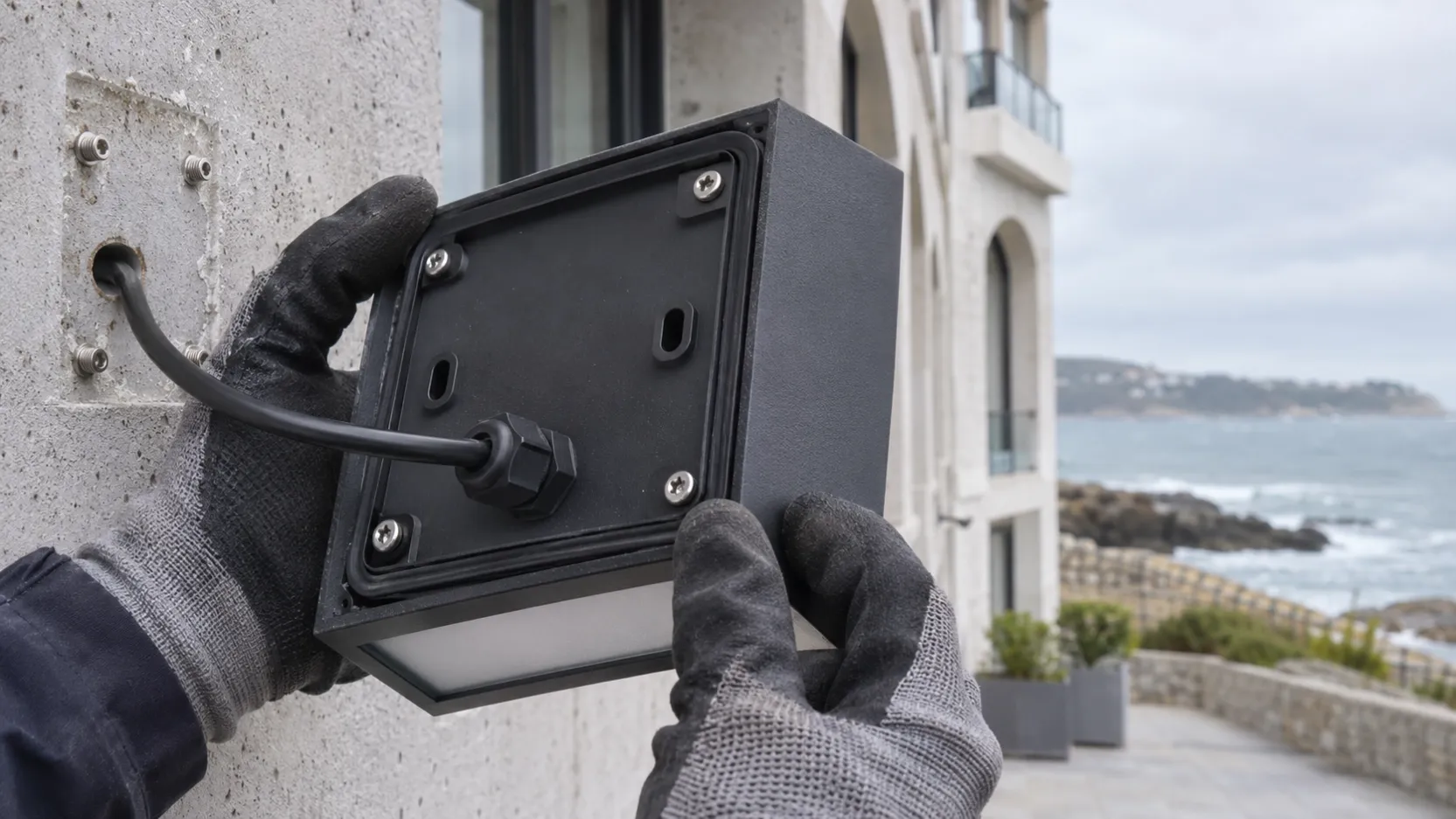
Do not approve an outdoor wall light for a coastal project based only on an IP65 rating or the words “aluminium housing.” Before ordering, the buyer should verify the housing and surface finish, fastener materials, sealing details, available corrosion evidence and warranty terms for the exact model and finish being supplied.
This is especially important for hotels, resorts, apartments and public buildings exposed to salt-laden air. A luminaire may resist rain but still develop corrosion around screws, coating edges, cable entries or joints if its materials and finishing process are unsuitable for the installation environment.
Why is IP65 not enough for a coastal project?
IP65 and corrosion resistance answer two different questions. An IP rating describes the enclosure’s protection against access, solid objects and water ingress. It does not certify resistance to salt, coating deterioration, ultraviolet exposure or corrosion.
IEC 60529 specifically treats corrosion as an external condition outside the scope of the IP classification. An IP65 wall light may therefore be protected against dust and water jets while still requiring a separate review of its materials and finish for coastal use.
For procurement purposes, record the IP rating and the corrosion requirements as separate items in the specification. Do not use one as evidence of the other.
What coastal exposure information should the buyer provide?
“Coastal project” is too broad for a supplier to assess properly. A sheltered entrance several kilometres from the shoreline does not face the same exposure as a beachfront wall receiving direct wind, salt deposits and rain.
| Information to provide | Why it affects the selection |
|---|---|
| Approximate distance from the sea | Helps indicate the expected level of airborne salt exposure. |
| Direct sea spray or airborne salt only | Direct spray creates a more severe exposure than general coastal air. |
| Sheltered or fully exposed installation | Sheltered areas can retain moisture and salt because they receive less natural rinsing. |
| Wall material and mounting position | Water retention, drainage and contact with other materials can affect local corrosion. |
| Cleaning and maintenance plan | Regular fresh-water cleaning can reduce accumulated salt deposits. |
| Required service life and warranty | These requirements determine what evidence and warranty wording the buyer needs. |
Photos of the façade and a marked elevation are more useful than a request that simply says “outdoor wall light for a coastal hotel.” They allow the supplier to review exposure, mounting height, access for maintenance and the required light distribution.
Which material and finish details should be confirmed?
Is “aluminium housing” a complete material specification?
No. Aluminium is widely used for outdoor luminaires, but the word alone does not explain the alloy, surface preparation or coating system. These details influence how the finished housing performs after cutting, machining, coating and assembly.
Ask the supplier to confirm the housing material, pretreatment process, type of surface finish, available coating specification and production inspection method. If these details have not been verified for the selected model, they should remain confirmation items rather than assumed performance claims.
Does stainless steel automatically prevent corrosion?
No metal should be described as completely corrosion-proof. Stainless-steel grade, surface condition, fabrication, crevices and exposure all affect performance. A stainless-steel cover also does not prove that the complete luminaire—including screws, brackets and internal components—uses the same material.
If stainless steel is specified, ask which components are stainless steel and request the actual grade. Avoid accepting a general description such as “stainless parts” without a component list.
Why must the screws and mounting plate be checked?
Fasteners are common starting points for visible corrosion because they are exposed at joints and may be made from a different metal from the housing. Contact between dissimilar metals in a wet, salt-contaminated environment can increase the risk of galvanic corrosion.
The supplier should identify the materials used for exposed screws, the mounting plate and other external hardware. The buyer should also ask whether dissimilar metals are isolated and whether the fastening points remain protected after assembly.
What should a salt-spray report tell the buyer?
A statement such as “passed 500 hours” is incomplete without the test standard, test method, specimen description, exposure duration and acceptance criteria. The buyer also needs to know whether the tested sample uses the same material, pretreatment, colour and finish as the product being ordered.
ISO 9227 describes neutral salt spray and other salt-spray test methods. The standard does not set a universal exposure duration or define how every product must be judged. It also does not convert test hours into years of outdoor service.
Salt-spray testing can help identify coating defects and monitor consistency within a defined process. It should not be used by itself to claim that one material will last a specific number of years beside the sea.
Before accepting a report, confirm:
- the test standard and test method;
- the exact material and finish tested;
- the duration of exposure;
- the pass-and-fail criteria;
- the date and issuing laboratory;
- whether the tested construction matches the ordered product.
What sealing and installation details still matter?
Corrosion review does not replace water-ingress review. The cable entry, gaskets, joints, drainage path and wall interface still need to suit the installation. A correctly rated luminaire can be compromised by an unsuitable cable gland, damaged gasket, unsealed wall penetration or incorrect mounting orientation.
Ask for installation instructions before approving the order. The installer should follow the stated mounting direction, preserve the seals, use suitable external cabling and prevent water from collecting behind the fixture.
How should the warranty be checked?
A general product warranty does not automatically cover surface corrosion, colour change, coating blistering or rust on external hardware. These conditions may be treated differently from an electrical failure.
Before ordering, ask the supplier to state in writing whether the warranty covers:
- corrosion of the housing;
- coating blistering, peeling or loss of adhesion;
- corrosion of screws and mounting hardware;
- installations exposed to salt air or sea spray;
- any required cleaning or maintenance conditions.
If corrosion coverage is not stated, do not assume it is included.
How should buyers approve a coastal wall light?
Use a staged approval process instead of choosing from a catalogue image alone.
- Send the project location, façade photos, installation position and expected quantity.
- Confirm the exact model, housing material, finish, fasteners and mounting components.
- Request corrosion-related evidence available for that exact construction and finish.
- Review the installation instructions and warranty exclusions.
- Order a sample in the required colour and inspect the coating, joints, screws, cable entry and mounting plate.
- Record the approved sample and specifications before authorising production.
This process does not guarantee that a luminaire will never corrode. It gives the buyer a traceable basis for comparing proposals and prevents an ordinary outdoor specification from being mistaken for a verified coastal specification.
Can a standard DAYBREAK IP65 wall light be used beside the sea?
DAYBREAK’s DB-LWL-A06A adjustable rectangular wall light is listed with IP65 protection, 12W or 24W power options, black or white finishes and adjustable up-and-down beams.
These specifications make it a possible model for an outdoor project review, but they do not by themselves establish coastal corrosion suitability. For a coastal enquiry, DAYBREAK should first review the site exposure and then confirm the finish, external hardware, available supporting documents and warranty conditions for the exact version proposed.
Send the project location, distance from the shoreline, façade photos, mounting height, preferred finish and quantity. DAYBREAK can then review the application and advise what must be confirmed before sampling or quotation.
Frequently Asked Questions
Does IP65 mean an outdoor wall light is corrosion-resistant?
No. IP65 addresses protection against dust and water jets. It does not certify resistance to salt, corrosion, ultraviolet exposure or coating deterioration.
Is stainless steel always better than aluminium for coastal lighting?
Not automatically. Performance depends on the exact stainless-steel grade or aluminium alloy, surface treatment, component design, fasteners, installation environment and maintenance. Compare complete product specifications rather than material names alone.
How many salt-spray hours should a coastal wall light pass?
There is no universal number suitable for every project. The project specification must define the test method, duration and acceptance criteria. Test hours should not be presented as a direct prediction of outdoor service life.
Should buyers request a sample before placing a project order?
Yes. A sample allows the buyer to inspect the finish, joints, fasteners, cable entry and mounting system. The approved construction should then be recorded for production comparison.
What information should be included in a coastal lighting enquiry?
Include the project location, distance from the sea, direct or indirect salt exposure, installation photos, mounting position, preferred finish, required quantity, maintenance conditions and expected warranty.