Should a Commercial Project Use IP20 and IP65 Recessed Step Lights—or Standardise on IP65?
Compare mixed IP20/IP65 and all-IP65 recessed step-light specifications by installation area, cost, site control, and long-term maintenance.
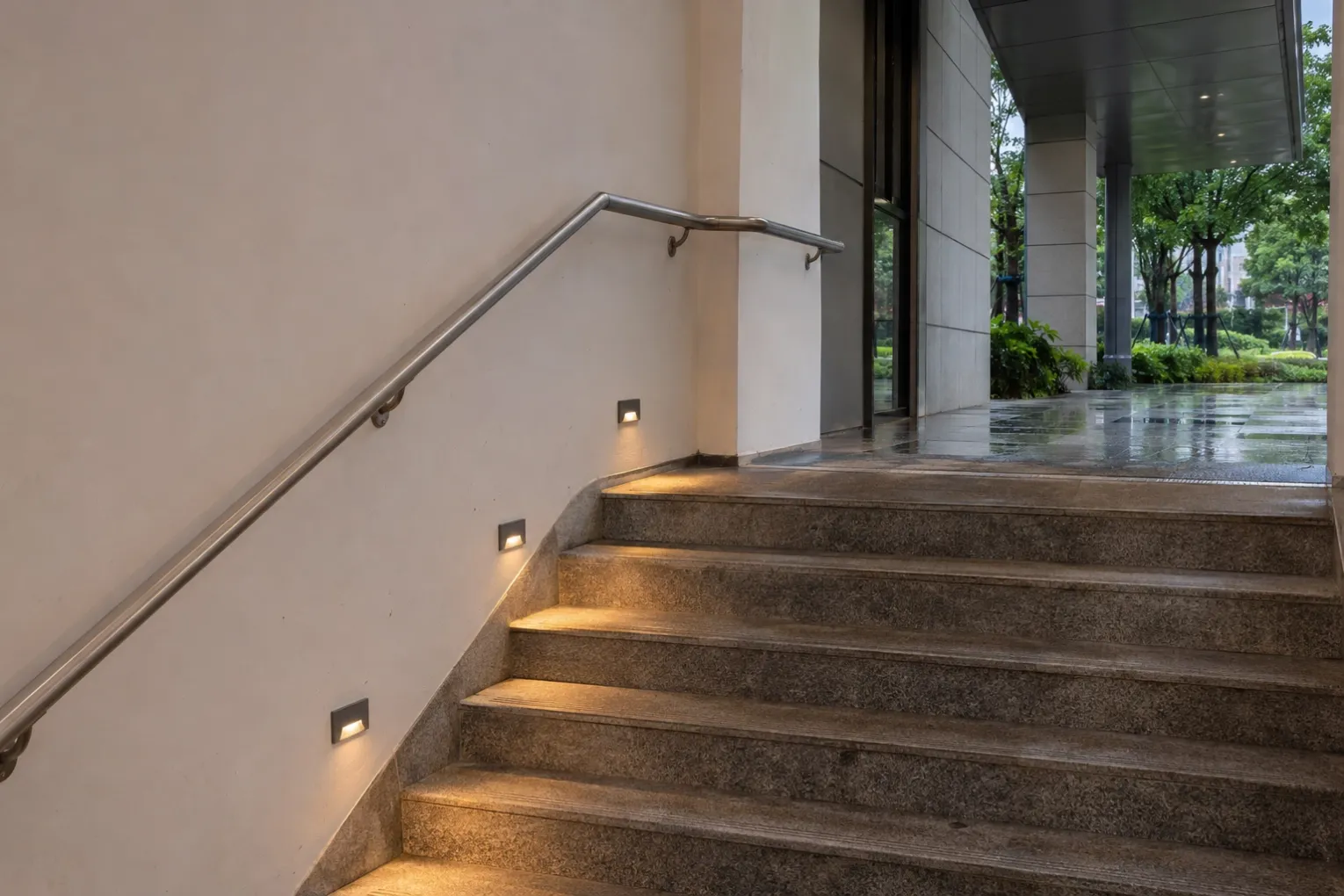
A commercial project should not specify every recessed step light as IP65 simply because the rating is higher. Use the installation environment to decide first. A mixed IP20/IP65 schedule may be more economical when most fittings are installed in reliably dry indoor areas. Standardising on one IP65 model may be more practical when moisture exposure is uncertain or when using one model can reduce ordering, installation and maintenance errors.
What does the IP rating tell the buyer?
The IP code classifies the protection provided by an electrical enclosure against access, solid objects and water. The classification is covered by IEC 60529.
An IP rating does not, by itself, confirm that a step light is suitable for every location. Buyers must also consider the installation method, cable connection, wall construction, drainage, local regulations and the manufacturer’s instructions.
When does a mixed IP20 and IP65 schedule make sense?
A mixed schedule can make sense when the project drawings clearly separate dry indoor areas from locations exposed to moisture.
| Installation area | Specification direction |
|---|---|
| Dry internal stairs and corridors | Review whether the specified IP20 model meets the project requirements |
| Covered entrances exposed to damp conditions | Consider a suitable IP65 model |
| Outdoor steps and pathways | Review IP65 or the rating required by the project designer |
| Areas cleaned with water | Confirm the cleaning method and expected water exposure |
For a project requiring 500 indoor units and 50 moisture-resistant units, a mixed specification may avoid paying for protection that is not required in every location. However, the project team must control two model numbers correctly from ordering through installation.
When can standardising on IP65 be more practical?
An all-IP65 proposal may be worth reviewing when the boundary between dry and damp areas is unclear, or when one model can be used throughout the project without changing the required appearance, dimensions or lighting result.
Using one model may provide several practical benefits:
- One product code instead of separate IP20 and IP65 references
- Lower risk of sending the wrong version to an installation area
- Simpler site allocation and stock control
- One spare-light specification for future maintenance
- More consistent appearance and light effect across the project
These benefits do not automatically make the all-IP65 option less expensive. Buyers should compare the complete proposal before deciding.
What should be compared in the technical proposal?
| Technical item | What the buyer should confirm |
|---|---|
| Faceplate size | Whether IP20 and IP65 versions have the same visible dimensions |
| Cut-out and wall depth | Whether both versions fit the planned opening and wall construction |
| Mounting parts | Whether an embedded box or other first-fix component is required |
| Cable connection | How the connection must be made to maintain the intended protection |
| Light direction | Whether both versions produce a comparable step-lighting effect |
| CCT and finish | Whether 2700K and the required housing finish are available for both versions |
| Unit weight | Whether the wall structure and fixing method are suitable |
How should buyers compare the economic proposal?
Do not compare only the two unit prices. The commercial review should include the costs and risks created by using one or two specifications.
| Commercial factor | Mixed IP20/IP65 | All IP65 |
|---|---|---|
| Number of models | Two models to order and control | One model may simplify control |
| Product cost | May be lower for dry indoor areas | Must be quoted for the full quantity |
| Site sorting | Each version must reach the correct area | Less risk of mixing versions |
| Spare units | Both versions may need to be retained | One spare specification may be sufficient |
| Packing and freight | Confirm packed size and weight for both models | Confirm the total packed weight of the IP65 option |
If the IP65 version has a different body, mounting box or packed weight, the change may affect installation and freight. Ask the supplier to state product size, unit weight, carton quantity, carton dimensions and gross weight in the proposal.
How should 2700K be controlled across the project?
If both IP20 and IP65 models will be visible in connected areas, confirm that both can be supplied in the required 2700K configuration. Review illuminated samples together rather than approving each model separately.
The purchase specification should record the agreed CCT, housing finish, faceplate appearance and light opening. Do not rely only on descriptions such as “warm white.”
What information should buyers send before requesting both options?
- Installation-area schedule showing dry, damp and outdoor locations
- Quantity required for each area
- Reference photo or required faceplate design
- Faceplate size, cut-out and available wall depth
- Required CCT and housing finish
- Wall construction and first-fix details
- Project country and applicable specification
- Required product and packed-weight information
Ask the supplier to quote both alternatives against the same confirmed requirements: one mixed IP20/IP65 schedule and one all-IP65 schedule. This makes the technical and economic comparison meaningful.
Frequently Asked Questions
Is IP65 always better than IP20 for recessed step lights?
IP65 provides a higher enclosure-protection classification, but the correct choice depends on the installation environment, project requirements and installation details.
Can IP65 step lights also be installed indoors?
They may be suitable for indoor use if their dimensions, installation method, light output and other specifications meet the project requirements. Confirm this with the supplier and project designer.
Can IP20 and IP65 step lights look identical?
Possibly, but do not assume they do. Compare the faceplate, light opening, dimensions, finish and illuminated appearance before approval.
Should buyers keep separate spare units for IP20 and IP65 models?
If the project uses two non-interchangeable models, separate spare units may be required. A single IP65 specification may simplify future replacement if one model is suitable for every approved location.
Does an IP65 rating cover an incorrectly installed cable connection?
No assumption should be made. The complete installation must follow the product instructions and project requirements, including cable entry, connection and sealing details.
What is the next step?
Send DAYBREAK the installation-area schedule, quantities, wall details, required dimensions, 2700K requirement and reference design. We can compare a mixed IP20/IP65 proposal with an all-IP65 option, including product size, unit weight and packing information.
View recessed LED step lights or submit your project requirements.