What Should Buyers Check Before LED Lighting Shipment?
Check LED lighting specifications, appearance, function, and packaging before shipment. Use this practical checklist to review your next order.
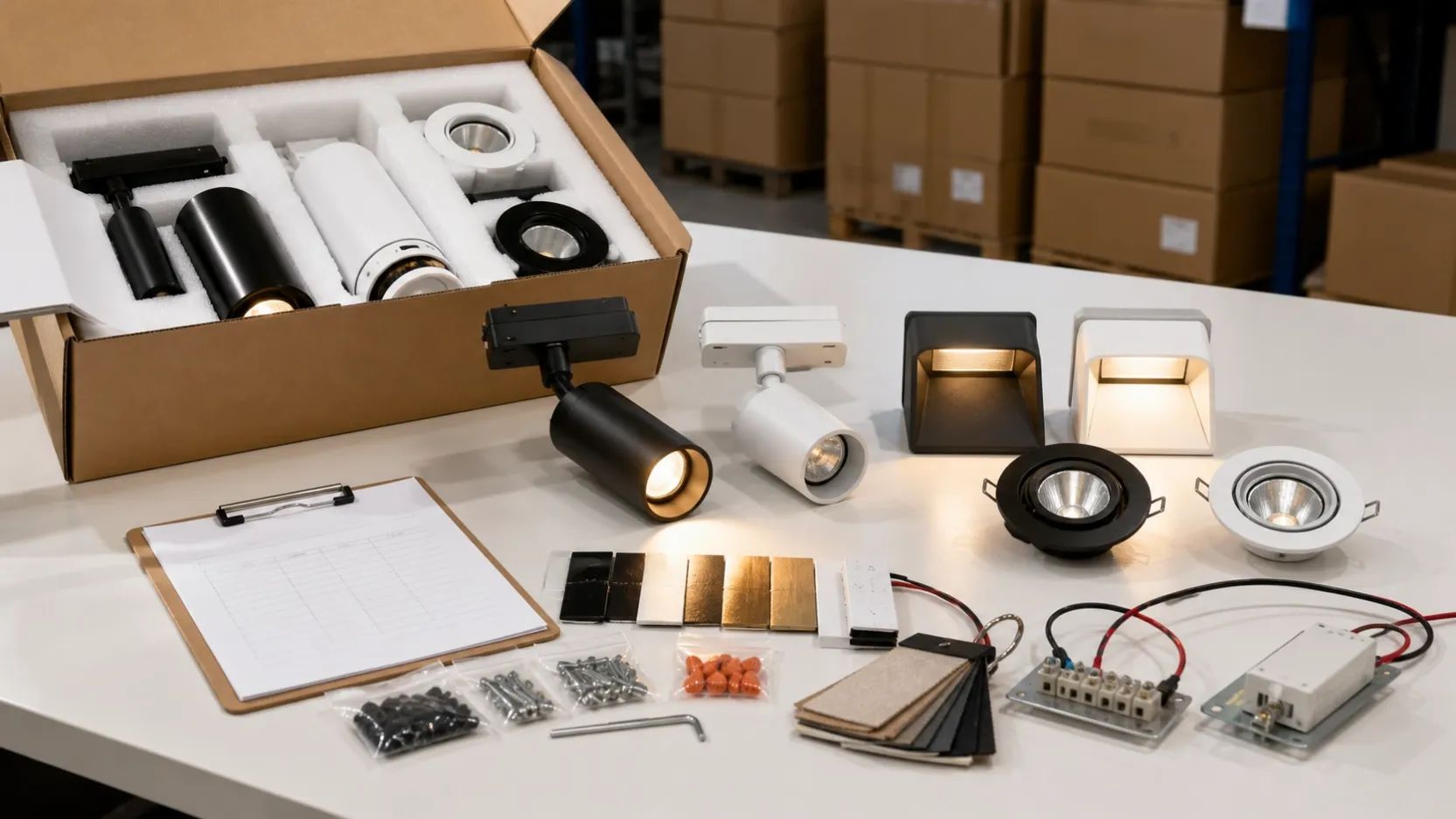
Before LED lighting shipment, compare the supplied goods, packaging and records with the approved order and inspection plan. Check four things: the product matches the approved order, the cartons match the packing list, a sample has been opened and powered, and the documentation matches the shipment. Agree sampling, acceptance criteria and how deviations will be resolved before dispatch.
Key facts about pre-shipment checks
- Open a carton — sealed cartons hide labelling and damage errors.
- Power a sample — appearance inspection does not prove function.
- Match cartons to the packing list, not to the total quantity.
- Documents must match the configuration, not a similar model.
- Photograph the packed pallet before the container closes.
Does the product match the approved order?
| Check | Why |
|---|---|
| Model number on the label | Catches substitution |
| Wattage and CCT | Compare with the approved configuration |
| Finish | Match to the approved sample |
| Beam pattern | Confirm against the sample |
| Driver model | Prevents an undeclared substitution |
Check these on the units themselves, not on the packing list. The list describes what should be there; the carton contains what is.
What should be checked when the lights are powered?
- Have qualified inspection personnel perform functional tests under the agreed sampling plan and safe test procedure.
- Check for flicker at full output and at low dim.
- Confirm the CCT against the approved sample.
- Test sensor or dimming functions where fitted.
- Check for audible noise from the driver.
- Where temporal light performance is specified, request suitable measurement evidence under agreed operating conditions. A phone video is not a calibrated acceptance test.
Which appearance details matter?
- Finish consistency across units in the same carton
- Scratches, dents and paint defects
- Gasket seated correctly and not pinched
- Gland tight and cable entry clean
- Screws present and correctly seated
- Lens or diffuser free of marks
Why should packaging be opened and reviewed?
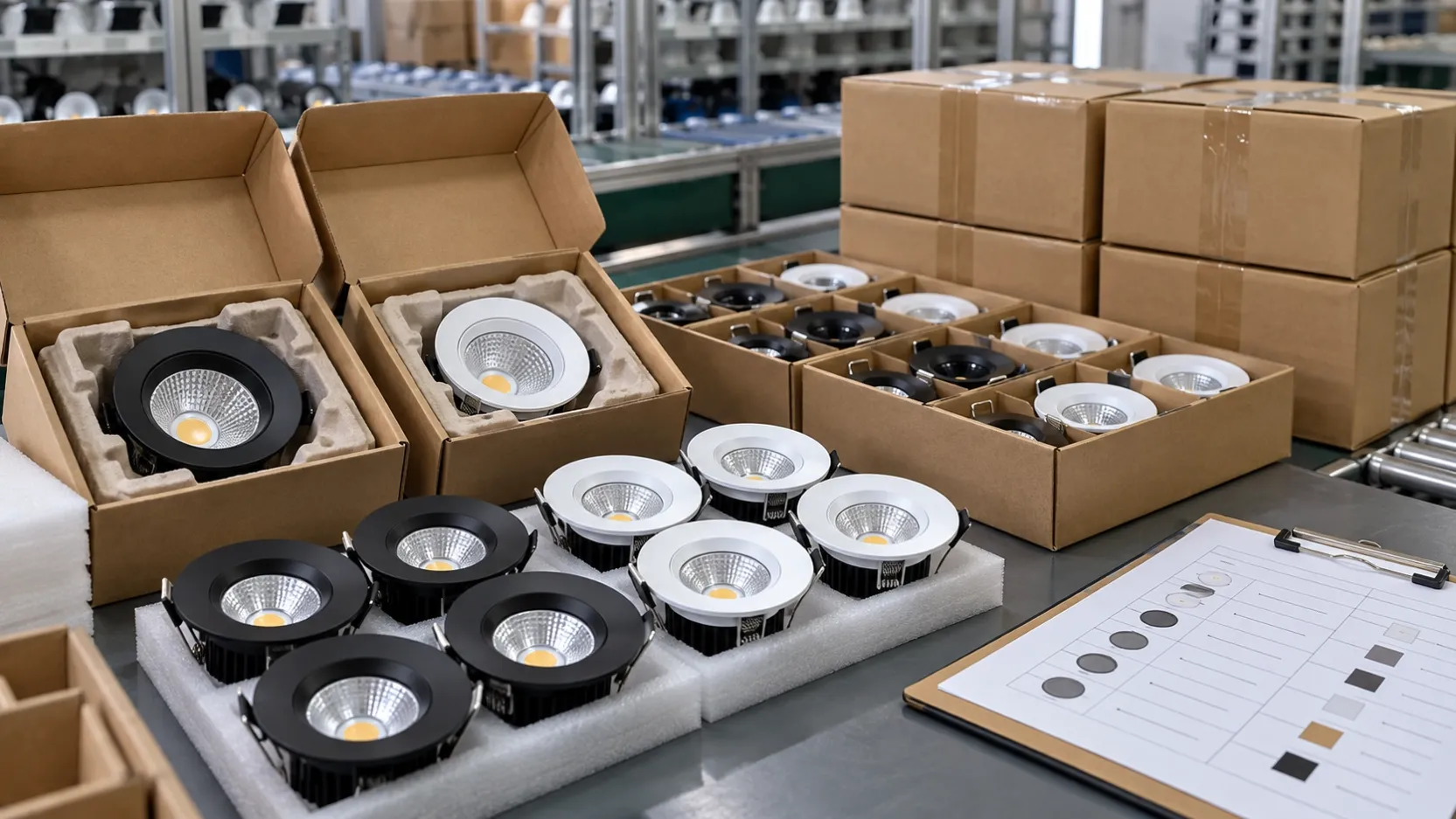
Packaging failures become transit damage and, later, warehouse complaints. Opening a carton allows the inspector to check the protection layout, accessories and product fit; it does not by itself prove transport performance.
| Check | Failure if missed |
|---|---|
| Inner foam or divider | Products knock together in transit |
| Carton strength | Crushed corners and damaged units |
| Label position | Warehouse cannot scan or identify |
| Accessories | Missing screws or manuals on site |
| Master carton quantity | Short shipment discovered at receiving |
What documents should be verified?
| Document | What to check |
|---|---|
| Packing list | Model, quantity, cartons, weights, dimensions |
| Commercial invoice | Matches the order and the packing list |
| Compliance documents | Match the supplied configuration |
| Test reports | Cover the wattage and driver supplied |
| Manual | Correct language and model |
Check the stated scope of each document against the supplied model and configuration. Ask for clarification where a report covers a product family or several variants; do not infer coverage from a similar model name.
How should the shipment be recorded?
- Photograph the packed cartons with labels visible.
- Photograph the pallet or container loading.
- Record carton counts against the packing list.
- Keep the inspection photos with the shipment documents.
- Note any deviation and confirm it in writing before loading.
Which product ranges follow this inspection?
The LED wall lights, step lights, garden bollards and commercial lighting ranges can be reviewed using a model-specific inspection plan. Send your order reference, destination market and acceptance requirements so DAYBREAK can confirm the agreed checks and available records.
Frequently asked questions
Should every carton be opened?
Agree the sampling scope before inspection, including coverage across models and batches, defect criteria and actions if a defect is found. The required scope depends on the order and inspection plan; do not assume one opened carton is sufficient.
What if the driver differs from the order?
Stop the shipment and confirm in writing. An undeclared driver substitution changes performance and may invalidate the compliance documents.
Is a photo of the carton enough?
No. Photos document only what is visible. Combine them with the agreed identity, quantity, functional and documentation checks, and record the sample coverage and results.
Who should do the inspection?
The supplier's QC for routine checks, or a third-party inspector on larger orders. Either way, the record should be shared with the buyer before loading.
What if a problem is found?
Resolve it before loading. Fixing a carton in the factory is cheap; fixing it on site is not.