How to Choose the Right LED Downlight Cutout Size for Renovation Projects?
Learn how to match LED downlight cutout size, outer diameter and ceiling depth in renovation projects. Send us your opening sizes for model selection.
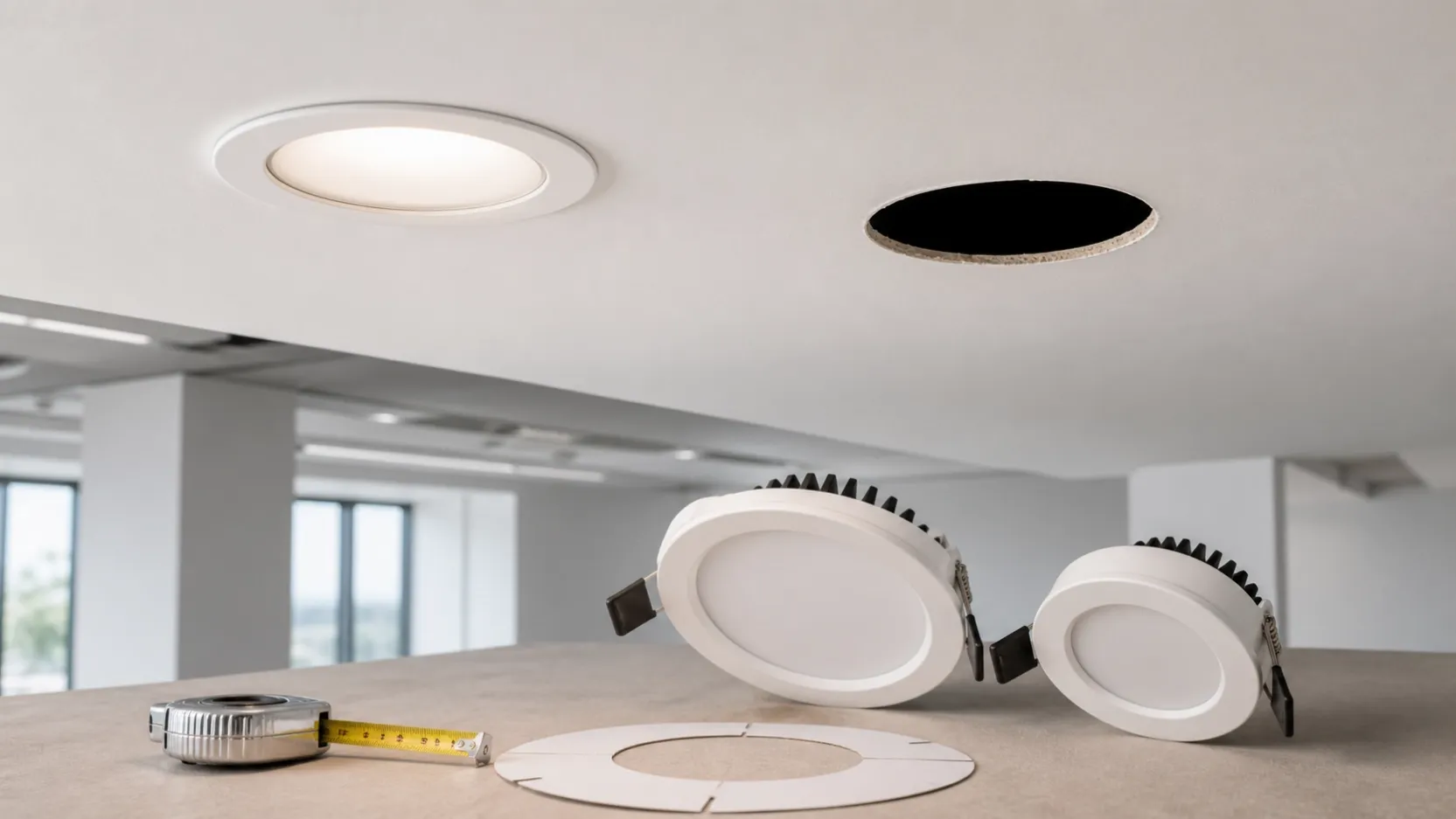
Cut-out size is the ceiling opening, not the fixture diameter. Measure the existing opening in the renovation, then choose a downlight whose cut-out matches it and whose mounting arrangement is approved for the actual opening. Getting this wrong means cutting plaster after decoration, or returning the order.
Key facts about downlight cut-out sizes
- Cut-out ≠ diameter. A 100 mm downlight may need a 90 mm opening.
- Measure the actual hole, not the old fixture's spec sheet.
- Use model-specific tolerances — confirm the permitted opening range from the approved drawing.
- Trim diameter covers the gap; cut-out diameter is what the ceiling must be cut to.
- Ceiling void depth matters as much as the opening — the driver has to fit.
Is cut-out size the same as downlight diameter?
No. A downlight has three relevant dimensions, and buyers often confuse them:
| Dimension | What it means |
|---|---|
| Cut-out | The hole cut in the ceiling |
| Trim / bezel diameter | The visible face that covers the hole edge |
| Body diameter | The housing that sits above the ceiling |
A fixture with a 100 mm cut-out might have a 115 mm trim and a 95 mm body. If you order by "100 mm downlight" and expect a 100 mm hole, you may be wrong by several millimetres in either direction.
How should an existing ceiling opening be measured?
- Have a qualified installer isolate the supply and make the installation safe before removing the old fixture.
- Measure the opening at two points, horizontally and vertically.
- Measure the clearance above the ceiling — the void depth.
- Check the distance from joists and services.
- Record the ceiling material and thickness.
| Measurement | Why it matters |
|---|---|
| Opening width (×2) | Confirms roundness and actual size |
| Void depth | Must clear the body plus driver |
| Ceiling thickness | Affects spring clip grip |
| Joist clearance | Prevents cutting into structure |
What if the opening is slightly too large?
An oversized opening needs an approved fixing and coverage solution. Review these options against the ceiling condition and model instructions:
- Choose a model with a larger trim diameter but the same cut-out range
- Use a conversion plate or mounting ring
- Patch and re-cut the ceiling — last resort, and expensive after decoration
Confirm trim coverage, spring support, ceiling condition and any required sealing or fire-performance details against the approved installation instructions. A wide trim alone does not establish a secure or suitable fit.
What if the opening is too small?
A smaller opening means cutting more plaster, which is messy but straightforward before decoration and problematic after. Options:
- Choose a smaller downlight that fits the existing hole
- Have the installer assess whether enlargement is permitted, including structure, services and any ceiling performance requirements
If the ceiling is already decorated, a smaller fixture is almost always the better answer than re-cutting.
Why does the ceiling void matter?
| Check | Evidence needed |
|---|---|
| Body and driver envelope | Model drawing and cable or connector clearances |
| Thermal and insulation clearance | Manufacturer installation requirements |
| Access and serviceability | Approved driver position and removal route |
| Ceiling constraints | Installer confirmation of structure, services and required ceiling performance |
The driver is often deeper than the fixture body. If the driver is external, confirm where it will sit and whether it remains accessible for replacement.
What should buyers send to the supplier?
- Measured cut-out size, with the measurement method
- Ceiling void depth
- Ceiling material and thickness
- Number of units and room types
- Required CCT, beam angle and wattage
- Dimming protocol if controlled
- Photos of the existing opening with a tape measure in frame
A photo with a tape measure across the opening removes most of the ambiguity. It is faster than three emails of clarification.
Which downlights cover common cut-outs?
The commercial LED lighting range includes shallow, standard and adjustable downlights. Frequently specified for renovation projects:
- DB-DL10D — 7W–15W adjustable 60° downlight with Lifud driver.
- DB-DL6A — 24° deep recessed pinhole downlight for low-glare accent.
- DB-SLDL1-R — round COB downlight, surface or pendant mount, when the void is too shallow for recessed.
Frequently asked questions
Can I use a larger downlight in a smaller hole?
No. The cut-out must be at least the fixture's minimum cut-out. A larger trim can cover a hole that is too big, but not one that is too small.
How much tolerance is normal?
There is no universal allowance. Use the permitted cut-out range and tolerances for the selected model, and compare them with the measured opening.
What if the old hole is an unusual size?
Look for a model with an adjustable cut-out range or a conversion plate. Where neither exists, a shallow surface-mounted fixture avoids cutting altogether.
Does the driver fit through the cut-out?
Not always. Some drivers are larger than the opening and must be positioned through a separate access point. Confirm this before installation.
Should I order one sample before the full renovation?
Yes. Trial-fit the approved sample in a representative existing opening or mock-up. Check fixing, coverage, depth, driver access and the light effect before approving the full order or altering further openings.