Trimless or Trimmed LED Downlights: Which Fits Hotel Ceiling Projects?
Compare trimless and trimmed LED downlights for hotel ceilings, then send your ceiling plan for a project-specific fixture recommendation.
Trimless or Trimmed LED Downlights: Which Fits Hotel Ceiling Projects?
Choose trimless LED downlights for hotel areas where a seamless ceiling is part of the design, such as lobbies, lounges and premium guestrooms. Choose trimmed downlights where simpler installation, clean cut-out coverage and easier future replacement are more important, such as corridors, service areas and renovation projects. Neither type is automatically better: the correct choice depends on the ceiling material, construction stage, finish quality and maintenance plan.
What Is the Difference Between Trimless and Trimmed Downlights?
What is a trimless LED downlight?
A true trimless downlight normally uses a plaster-in or mud-in frame installed before the ceiling receives its final finish. The surrounding plaster conceals the mounting edge, leaving only the light aperture visible.
This creates a quiet, integrated ceiling appearance. It also requires early coordination between the lighting supplier, ceiling contractor and electrical installer.
What is a trimmed LED downlight?
A trimmed downlight has a visible flange that sits over the ceiling cut-out. The trim provides a defined edge and can cover small variations around the opening.
Installation is usually more straightforward because the fixture can be fitted after the main ceiling finish is complete. Trimmed models are also practical for renovation projects and areas requiring regular access.
| Comparison | Trimless Downlight | Trimmed Downlight |
|---|---|---|
| Ceiling appearance | Seamless, minimal aperture | Visible but clearly finished edge |
| Installation stage | Coordinated before final plastering | Often installed after ceiling finishing |
| Cut-out tolerance | Requires accurate finishing | Trim helps cover the cut-out edge |
| Future ceiling changes | May require plaster repair | Generally easier to replace |
| Typical hotel use | Lobby, lounge and premium areas | Corridor, guestroom and renovation areas |
Which Downlight Fits Each Hotel Area?
Which type is suitable for hotel lobbies?
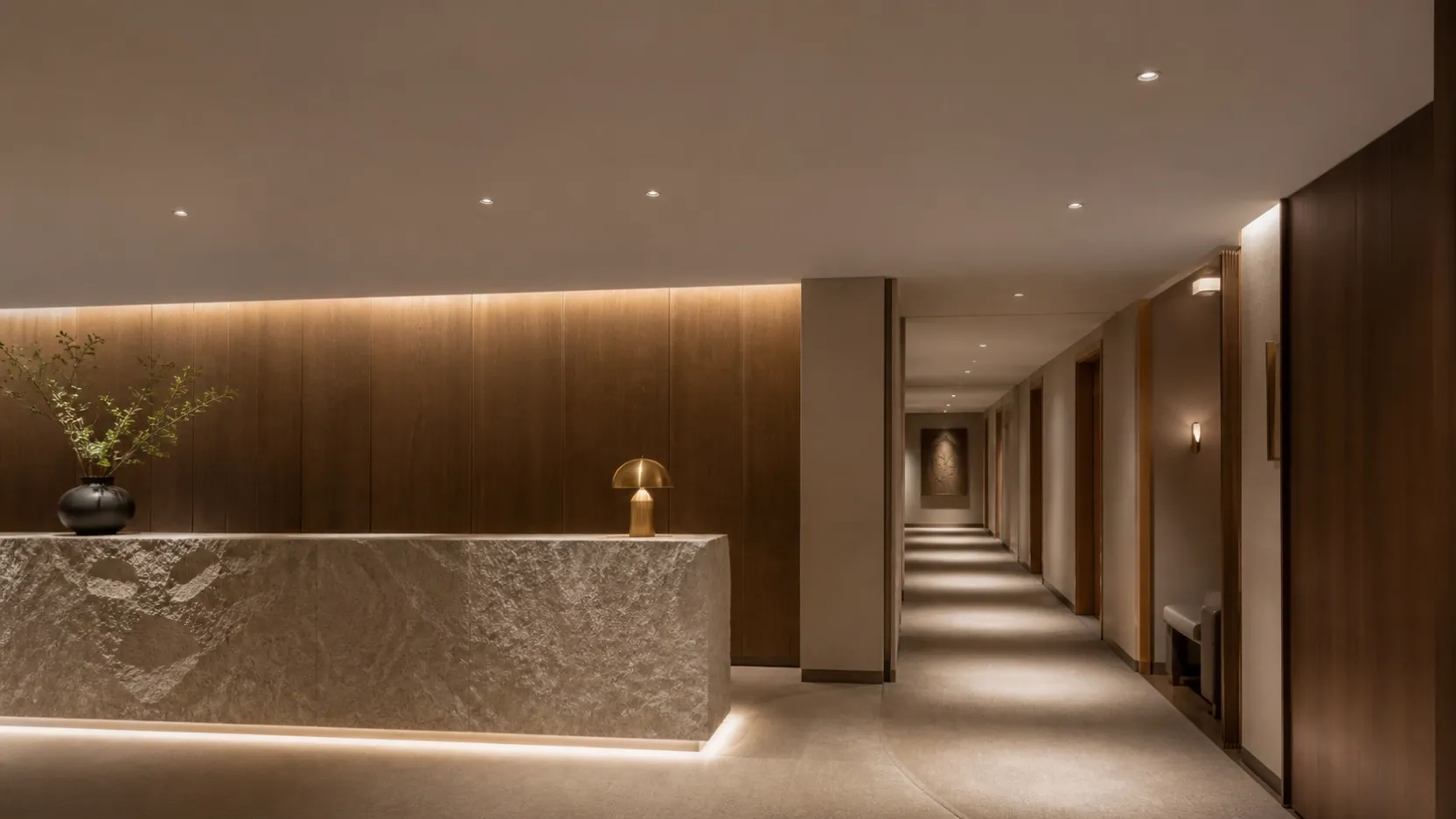
Trimless downlights suit hotel lobbies when the architect wants an uninterrupted plaster ceiling. Their discreet appearance allows decorative pendants, wall finishes and interior materials to remain the main visual elements.
Trimmed downlights remain suitable when the ceiling has visible joints, access panels or other architectural details. A carefully selected trim colour can coordinate with the ceiling instead of competing with it.
Which type works better in hotel corridors?
Trimmed downlights are often practical for repeated corridor installations because they simplify ceiling openings and future replacement. Trimless fixtures can still be used when the corridor forms part of a continuous architectural ceiling concept.
For corridors, beam angle, spacing and glare control usually have a greater effect on the lighting result than the presence of a narrow trim.
Which type should be used in guestrooms?
Either type can work in guestrooms. Trimless downlights support a minimal interior, while trimmed downlights provide straightforward installation across a large number of repeated rooms.
The project team should also consider deep-set optics, color temperature, dimming compatibility and access to the driver. These details directly affect guest comfort and long-term maintenance.
Which Ceiling Materials Work with Trimless Downlights?
Can trimless downlights be installed in every ceiling?
No. Plaster-in trimless frames are mainly designed for compatible plasterboard or rendered ceiling systems. Timber, metal, concrete and modular ceilings may require different mounting details.
Before ordering, confirm:
- Ceiling material and thickness
- Cut-out dimensions
- Required ceiling void
- Plaster-in frame dimensions
- Driver location and access
- Installation sequence
For timber or decorative panel ceilings, a trimmed model can provide a controlled transition between the fixture and the material. A dedicated trimless detail may also be possible, but it must be coordinated with the ceiling fabricator.
How Does Maintenance Affect the Decision?
Does trimless mean the complete ceiling must be opened?
Not necessarily. Some trimless systems allow the light engine, reflector or driver to be removed through the aperture. Others require more extensive access. The maintenance method depends on the product structure, not simply the word “trimless.”
For hotels with hundreds of guestrooms, the buyer should confirm which components can be replaced from below and whether spare drivers, optical parts and light engines will remain available.
What Should Buyers Confirm Before Ordering?
Which details should appear in the downlight schedule?
| Project Detail | Why It Matters |
|---|---|
| Trimmed or true plaster-in structure | Defines the installation method |
| Ceiling cut-out and void depth | Confirms physical compatibility |
| Fixed, adjustable or wall-wash optic | Matches the lighting purpose |
| Beam angle and photometric file | Supports spacing and coverage calculations |
| Color temperature and color consistency | Keeps repeated hotel areas visually uniform |
| Driver and dimming method | Ensures compatibility with the control system |
| Maintenance access | Reduces future disruption |
How Should You Make the Final Choice?
Specify trimless downlights where seamless ceiling integration justifies the additional coordination. Use trimmed downlights where installation flexibility, cut-out coverage and convenient replacement have greater value. A hotel may use both types in different areas while maintaining consistent light quality and appearance.
View our LED downlight category and hotel lighting applications to compare available structures, beam angles and installation options. For a project-specific recommendation, send us your reflected ceiling plan, ceiling material, cut-out requirements and fixture schedule.
Frequently Asked Questions
Are trimless downlights more difficult to install?
They require closer coordination because the mounting frame is normally installed before final plastering. Accurate positioning and ceiling finishing are important.
Can trimless downlights be replaced after installation?
Many designs allow internal components to be removed through the aperture, but this varies by product. Confirm the replacement procedure before approval.
Are trimmed downlights suitable for luxury hotels?
Yes. A well-proportioned downlight with a discreet trim, controlled optics and a finish coordinated with the ceiling can suit both luxury and standard hotel areas.
Can trimmed and trimless downlights be used in the same hotel?
Yes. Trimless fixtures may be selected for prominent architectural areas and trimmed fixtures for guestrooms, corridors or service zones. Keep the color temperature, color consistency and lighting effect coordinated across connected spaces.