How to Choose Durable Outdoor Wall Lights for Commercial Projects?
Sourcing outdoor lighting? Learn how to pick wall lights that survive the elements, focusing on IP ratings, materials, and maintenance-free designs for B2B projects.

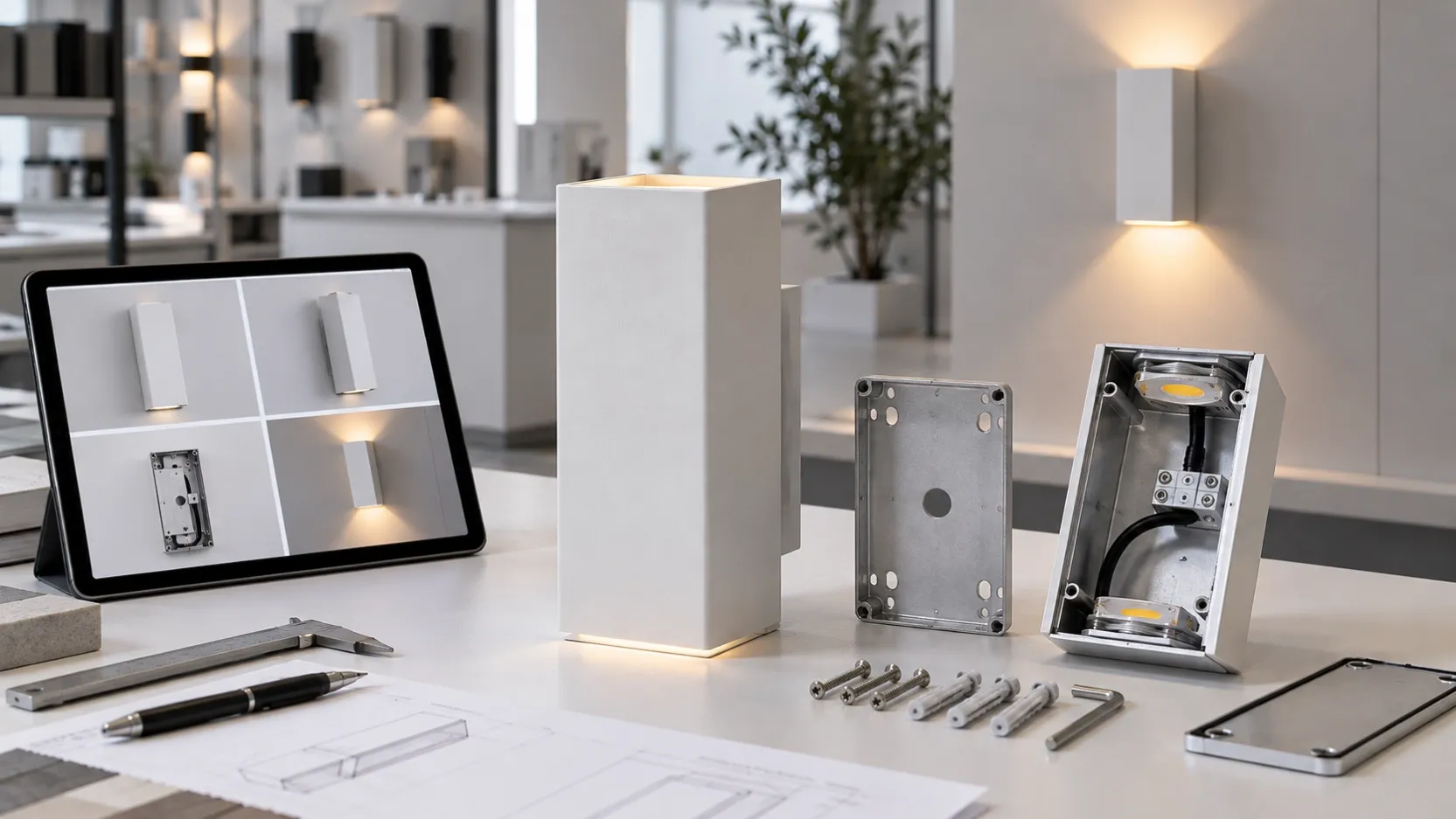
Durable outdoor wall lights are decided by four things: housing material, the sealing at gland and gasket, the driver, and the finish system. IP ratings and lumen output are visible on the datasheet; these four determine whether the fixture still works after three years on the wall.
Key facts about outdoor wall light durability
- Die-cast aluminium housings resist impact and dissipate heat; pressed steel dents and corrodes.
- IP65 is the minimum for exposed walls; IP44 only works under cover.
- The rear gasket and cable gland decide whether the rating holds after installation.
- The driver is the first component to fail in most outdoor fixtures.
- Stainless fasteners prevent the corrosion that starts at screw heads.
Material: why aluminium beats the rest
| Material | Heat | Impact | Coastal |
|---|---|---|---|
| Die-cast aluminium | Good | Good | Good with specified finish |
| Extruded aluminium | Good | Fair | Good |
| Stainless steel | Fair | Excellent | Excellent |
| Pressed steel | Fair | Poor | Poor |
| Engineering plastic | Poor | Fair | Good |
Heat matters more than buyers expect. An outdoor wall light may run eight hours a night through summer, and LED lifetime depends on junction temperature. A housing that cannot dissipate heat loses output and drifts in colour long before the LED fails outright.
Understanding IP ratings for real protection
| Rating | Tested protection | Where it suits |
|---|---|---|
| IP44 | Splashing water | Covered corridors, porch soffits |
| IP54 | Dust protected, splashing | Sheltered exterior |
| IP65 | Dust tight, water jets | Exposed facades, entrances, coastal |
| IP66 | Dust tight, powerful jets | Washdown areas, pool surrounds |
The rating applies to the tested enclosure. It does not confirm that the unit installed on your wall has a seated gasket, a correctly sized gland and no mechanical stress on the housing. Those are installation and assembly factors, and they decide the real performance.
Light distribution: up, down, or both?
| Pattern | Best for | Watch out for |
|---|---|---|
| Up-and-down | Facade rhythm, hotel elevations | Upward light may breach local rules |
| Single downward | Entrances, signage, corridors | Less facade interest |
| Adjustable | Walls that need aiming on site | Set before handover, not after |
| Multi-beam | Decorative columns and corners | Harder to predict; sample first |
The B2B advantage: reliability and certification
For a distributor or contractor, a failed fixture costs far more than its price: a site visit, a replacement, and the client's confidence. That is why specification should focus on the components that fail first — the driver, the seals and the finish — rather than on the unit price.
Compliance documents matter too. CE, LVD, EMC and RoHS documentation should match the exact configuration ordered, not a similar model. Ask the supplier to confirm which documents cover the wattage and driver being supplied.
What should be confirmed before ordering?
| Item | Why |
|---|---|
| Housing material and thickness | Heat and impact |
| Rear gasket and compression | Whether the seal holds on an uneven wall |
| Cable entry direction | Water runs along cables into upward entries |
| Driver brand and model | First failure point |
| Finish system | Corrosion resistance |
| Fasteners | Stainless, not plated |
| Compliance documents | Match the ordered configuration |
Which models suit commercial projects?
The LED wall light range covers IP44 and IP65 models for covered and exposed walls. Frequently specified for commercial durability:
- DB-LWL-A06AIP65 — 6W/12W IP65 adjustable wall light for exposed facades.
- DB-LWL-A07A — 6W multi-beam IP65 for decorative elevations.
- DB-LWL-A03AIP65 — 8W IP65 up-and-down wall light for entrances.
Send the wall type, exposure and mounting height, and we will confirm the model and the sealing detail that matters for your site.
Frequently asked questions
Is IP65 necessary for all outdoor wall lights?
No. IP44 is adequate under a canopy or soffit. Use IP65 wherever the wall takes direct rain or washdown.
How long should an outdoor wall light last?
A well-specified fixture with a quality driver typically runs several years before the driver needs replacement. Cheap drivers fail much sooner, often within 12–24 months.
Can aluminium wall lights be used near the coast?
Yes, with a specified corrosion-resistant finish and stainless fasteners. Standard powder coat can chalk and blister in salt air.
Why do outdoor wall lights fog inside the lens?
Moisture is entering and condensing. Fogging is the earliest sign of a seal problem and usually precedes driver failure.
Should the driver be replaceable separately?
Ideally yes, because it is the most common failure point. Confirm that replacement does not require breaking the main enclosure seal.