Outdoor Wall Light Samples: 4 Checks Before Approval
Approve outdoor wall light samples on four checks: quotation match, wall fit, light effect and a written reference. Test three units, not one.
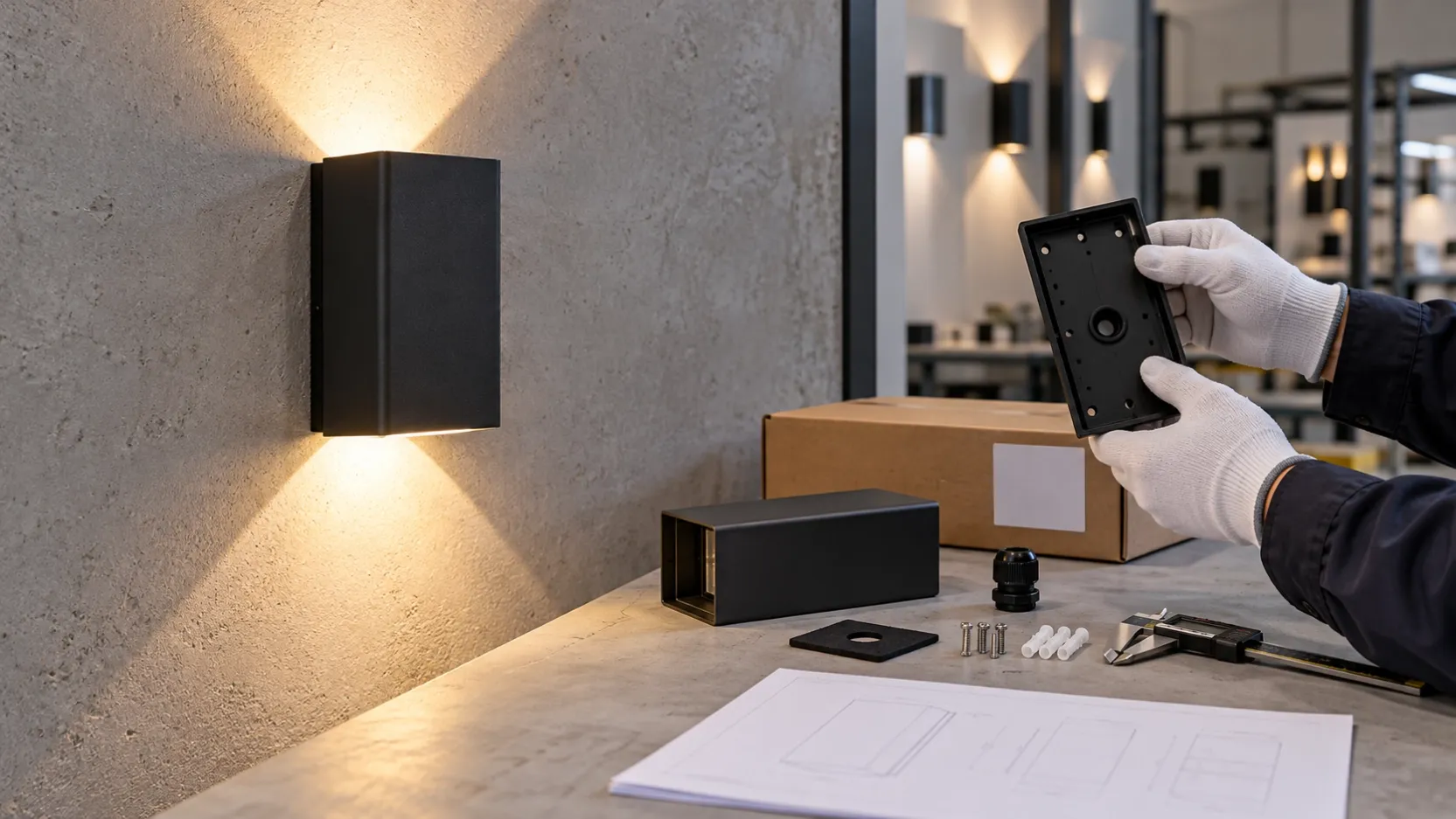
Approving an outdoor LED wall light sample requires four checks: configuration, installation fit, light effect and a written reference. A sample that switches on is not an approved sample. What matters is whether it matches the quotation, fits the actual wall, produces the required beam, and can be repeated in production.
This guide is written for contractors, distributors and specifiers approving samples for hotel, facade and commercial projects.
Key facts about sample approval
- One sample is not enough to judge colour consistency; compare at least three from the same batch.
- Bench testing hides installation problems; mount the sample on a representative wall section.
- The approved sample becomes the production reference, so its serial number and photos must be retained.
- An IP rating on the datasheet does not confirm the gasket on the sample you received.
- Dimming behaviour must be tested with the actual dimmer, not assumed from the driver label.
Check 1: does the sample match the quotation?
| Item | What to compare | Common discrepancy |
|---|---|---|
| Model and housing | Model number, dimensions, material | Similar housing with different internals |
| Wattage and output | Nominal wattage, delivered lumens | Wattage stated without lumen output |
| CCT and CRI | Nominal CCT, binning, Ra value | Different bin than the quoted batch |
| Beam angle | Optical distribution, not just degrees | Same angle, different optic design |
| Driver | Brand, model, dimming protocol | Unbranded driver substituted |
| Finish | Colour code and surface finish | Standard black substituted for RAL match |
| IP rating | Rating plus gasket and gland design | Rating claimed for a different model |
Photograph the sample label and compare it with the quotation line by line. A model number that does not appear on the quotation is a warning sign, not a detail.
Check 2: does it fit the project wall?
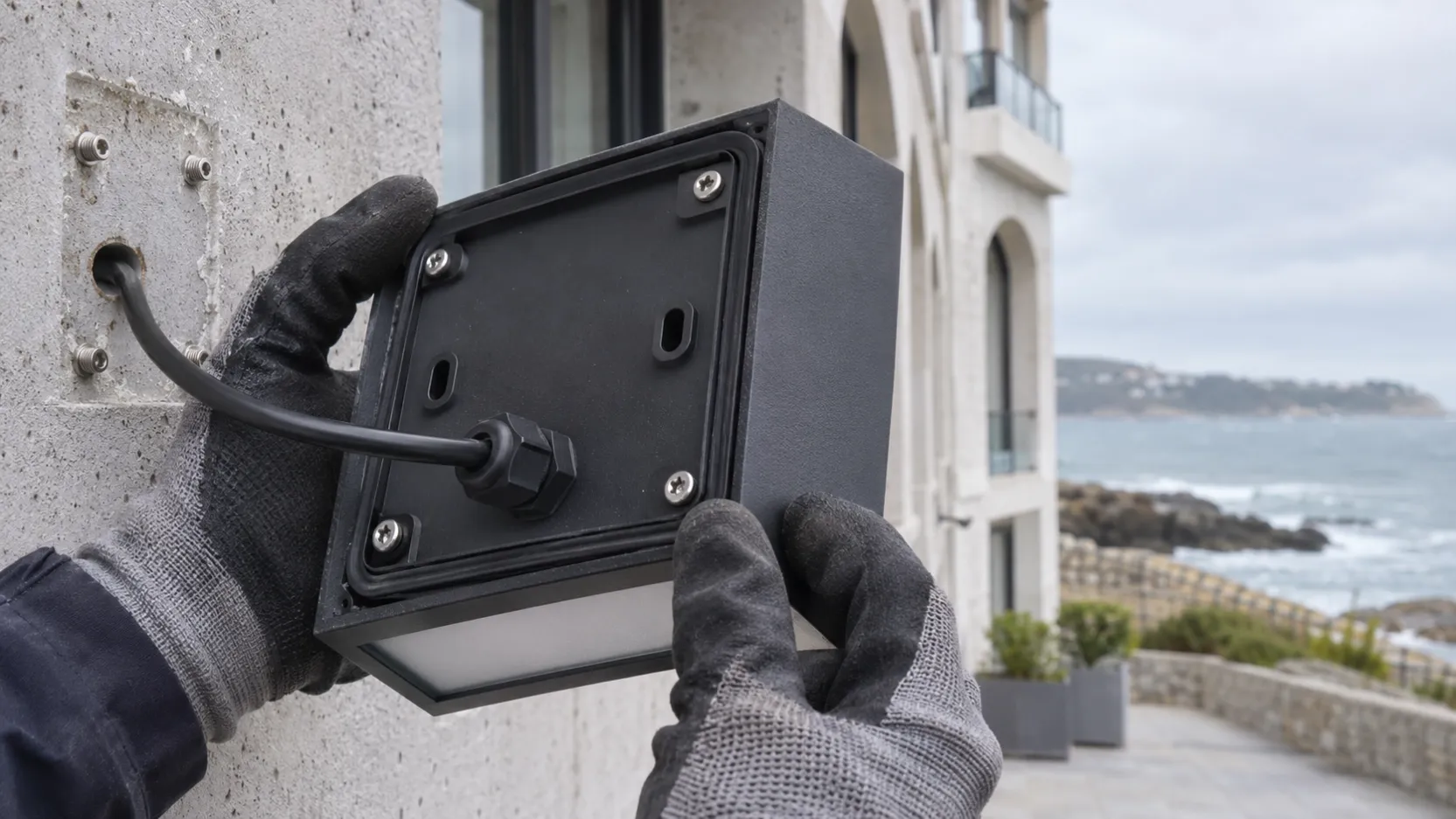
A sample can look correct on a bench and still delay the project because of the mounting detail. Check these before approving:
- Mounting plate dimensions against the wall opening or existing wall box
- Fixing hole spacing and screw type
- Cable entry position and direction
- Terminal block size and the cable diameter you will actually use
- Clearance behind the fixture for the driver and cable loop
- Whether the rear gasket can compress evenly on the wall surface
For renovation projects, measure the existing opening first. A 10 mm difference in mounting plate size can mean cutting stone or returning the order.
Check 3: does the light effect suit the project?
- Mount the sample on a similar wall — stone, render, timber and painted surfaces all read differently.
- View from the guest or customer position, not from directly below the fixture.
- Check both directions of travel for corridor and stair applications.
- Test at the actual mounting height, not at waist height on a bench.
- Dim to the lowest usable level and check for flicker.
- Photograph with fixed white balance so later comparisons remain valid.
- Compare against the adjacent interior lighting if the wall is seen through glass.
Check 4: what must be recorded?
| Record | Why it matters |
|---|---|
| Sample serial or approval date | Makes the reference traceable |
| Photo set of front, rear, label and mounting plate | Documents what was actually approved |
| Light-effect photo on the real wall | Settles later disputes about beam or CCT |
| Driver model as printed on the unit | Prevents substitution in bulk |
| Finish reference sample | Matches later production batches |
| Written approval with date and signatory | Becomes the production contract reference |
Why one sample is not enough
Colour variation, gasket fit and driver behaviour vary between units. A single sample cannot reveal:
- Whether the batch is binned consistently
- Whether the gaskets seat the same way on every unit
- Whether the drivers behave identically at low dim
- Whether the finish is uniform across the batch
For project quantities, compare three units from the same batch side by side, and keep one as the retained reference.
Which wall light models are commonly specified?
The LED wall light range includes IP44 models for covered areas and IP65 models for exposed facades. Frequently approved models:
- DB-LWL-A06AIP65 — IP65 adjustable-beam wall light, independently adjustable up and down.
- DB-LWL-A05A — 4W–12W IP65 multi-beam wall light with decorative up and down options.
- DB-LWL-A06AIP65-12WCCT — 12W IP65 cube wall light with CCT selection.
Send the model, quantity, finish, CCT, wall drawing and site photos for a sample review.
Frequently asked questions
Does an IP rating replace correct installation?
No. The rating applies to the tested enclosure. Cable routing, gasket compression and the wall surface still determine whether the installed unit stays dry.
Should buyers keep the approved sample?
Yes. Keep it until the bulk order has been inspected and accepted, and retain photographs as a secondary reference.
How many samples should be tested?
At least three from the same batch for project quantities. One sample cannot show colour variation or assembly consistency.
What should be sent for a sample review?
The model, quantity, finish, CCT, wall drawing, mounting height and site photos showing the actual exposure.
Should the sample be tested on site or at the office?
On site, wherever the wall is available. Bench testing cannot reveal how the beam reads against the real surface or whether the mounting plate fits the opening.
What if the approved sample differs from the bulk delivery?
That is what the recorded reference is for. Compare the delivered units against the retained sample and the photo set before accepting the shipment.