How to Choose LED Downlights for Commercial Projects?
Select commercial LED downlights by cut-out, installation depth, beam angle and dimming compatibility. Send your fixture schedule for model and specification review.
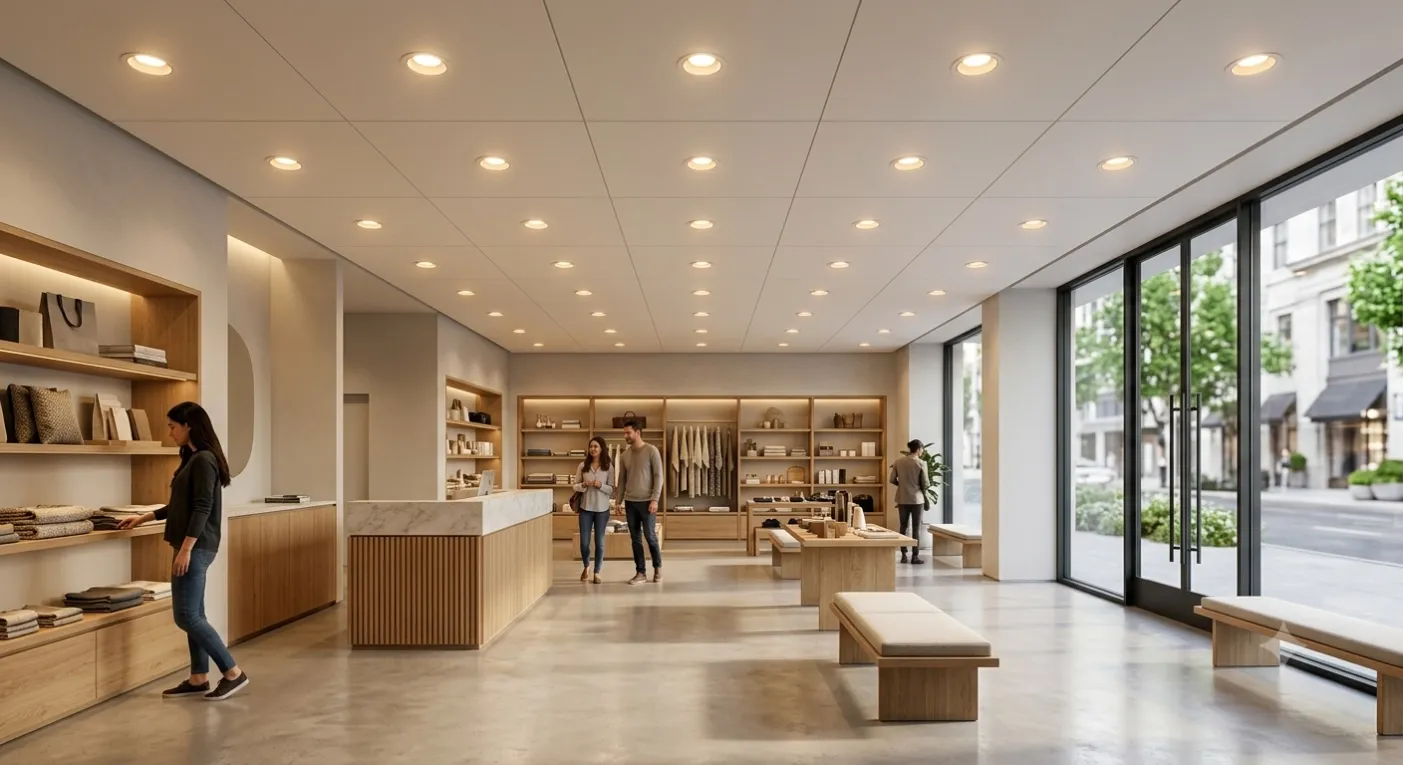
Choose LED downlights by four parameters in this order: cut-out size, beam angle, colour temperature and dimming. Everything else — trim style, wattage, finish — follows from those. Getting the order right avoids the two most common failures: a fixture that does not fit the ceiling, and a beam that puts light in the wrong place.
Key facts for downlight selection
- Cut-out first. It is set by the ceiling, not by preference.
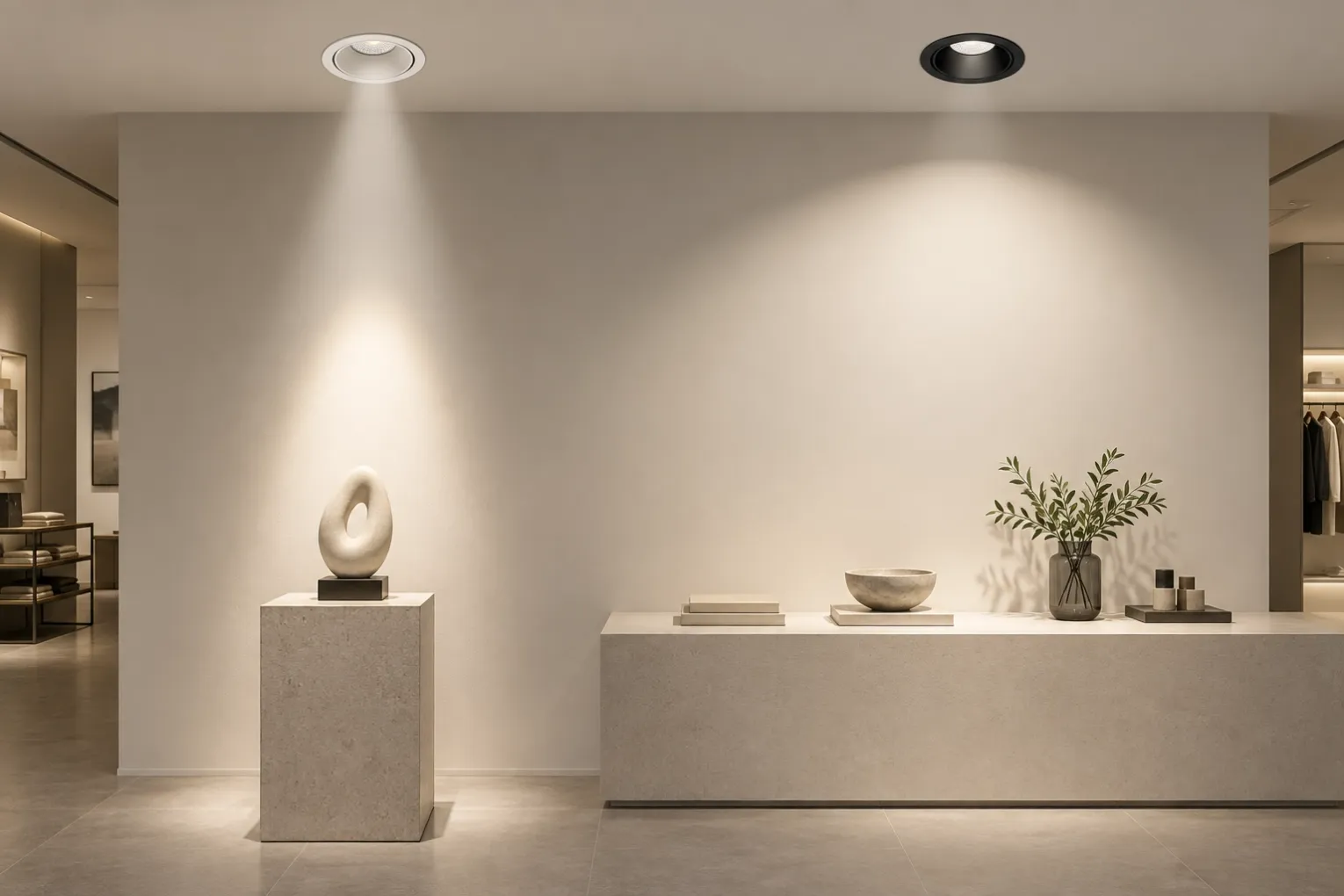
- Beam angle decides coverage. 24° for accent, 36° for general, 60° for wide wash.
- CCT consistency matters — specify binning, not just "3000K".
- Dimming protocol is a system decision — driver and dimmer must match.
- Void depth rules out deep fixtures in shallow ceilings.
1. Cut-out size comes first
The ceiling determines the opening. Measure the existing hole in a renovation, or set it from the ceiling design in new build. A downlight can only be selected once the opening and void depth are known.
| Cut-out | Typical use |
|---|---|
| 55–75 mm | Small accent, cabinetry, retail detail |
| 75–90 mm | Standard residential and light commercial |
| 90–150 mm | Commercial, hotel, higher output |
| 150 mm+ | High-bay or large-format commercial |
Check the void depth at the same time. A fixture that fits the opening but not the void cannot be installed.
2. Beam angle decides where the light lands
| Beam | Coverage at 3 m | Use |
|---|---|---|
| 24° | ~1.3 m | Accent, artwork, retail product |
| 36° | ~1.9 m | General retail, hospitality |
| 60° | ~3.5 m | Wide wash, offices, corridors |
Higher ceilings need narrower beams to keep intensity on the target. A 60° fixture at 5 m produces a soft, low-intensity pool, which is fine for general lighting but poor for accent.
3. Colour temperature and rendering
| CCT | Where it reads correctly |
|---|---|
| 2700K | Hospitality, residential, warm interiors |
| 3000K | Hotels, restaurants, retail — the most common commercial choice |
| 4000K | Offices, healthcare, task areas |
| 5000–6000K | Industrial, utility, security |
Specify binning tolerance as well as the nominal value. For a visible ceiling run, SDCM <3 keeps fixtures consistent side by side. For retail and gallery work, Ra 90+ (and R9 checked) matters more than the nominal CCT.
4. Dimming is a system decision
| Protocol | Best for | Watch out for |
|---|---|---|
| Trailing edge | Simple room dimming, retrofit | Needs adequate load; compatible driver |
| 0–10V | Larger zones, corridors | Separate control wiring |
| DALI | Full building control, scenes | Cost and commissioning |
"Dimmable" is not a specification. Name the protocol and the dimmer, or flicker complaints will follow after handover.
Then think about spacing
Downlight spacing follows from beam angle and mounting height, not from a fixtures-per-square-metre rule. At 3 m with a 36° beam, centres around 2–2.5 m give even coverage. Tighter spacing increases illuminance but also increases cost and ceiling clutter.
| Mounting height | 36° beam, even coverage |
|---|---|
| 2.5 m | 1.8–2.2 m centres |
| 3.0 m | 2.0–2.5 m centres |
| 4.0 m | 2.5–3.2 m centres |
What to check before ordering
- Actual cut-out and void depth, measured
- Beam angle against the target size
- CCT and binning, with the approved sample
- CRI and R9 where colour matters
- Driver brand, model and dimming protocol
- Flicker performance at low dim
- Trim style and finish against the ceiling
- IP rating if the location is damp or exterior
Which downlights cover each application?
The commercial LED lighting range includes deep recessed, adjustable and surface-mounted downlights. Frequently specified options:
- DB-SLDL1-R — 12W–40W round COB downlight, surface or pendant mount.
- DB-SLDL1 — 15W–40W square surface-mounted COB downlight.
- DB-DL10D — 7W–15W adjustable 60° downlight with Lifud driver.
Frequently asked questions
How many lumens do I need per square metre?
It depends on the task. Offices typically target 300–500 lux, retail 300–750 lux, hospitality 100–200 lux. Convert from the required lux and the fixture's delivered lumens rather than guessing wattage.
Is 24° or 36° better for a shop?
24° for displays and 36° for general floor coverage. Many shops use both, with narrower beams over merchandise.
Do all dimmable downlights work with all dimmers?
No. The driver and dimmer have to match, and the dimmer needs enough LED load. Name both in the purchase order.
Can downlights be used in a bathroom?
Yes, with the appropriate IP rating for the zone and a driver rated for humid conditions.
What is the most common downlight mistake?
Ordering by wattage instead of by cut-out, beam angle and driver. The result fits badly, lights the wrong area, or flickers.