How Do You Choose a Recessed COB Spotlight When the Ceiling Void Is Under 50mm?
Working with a ceiling void under 50mm? Check the true installation depth, driver space, and beam requirements before ordering recessed COB spotlights.
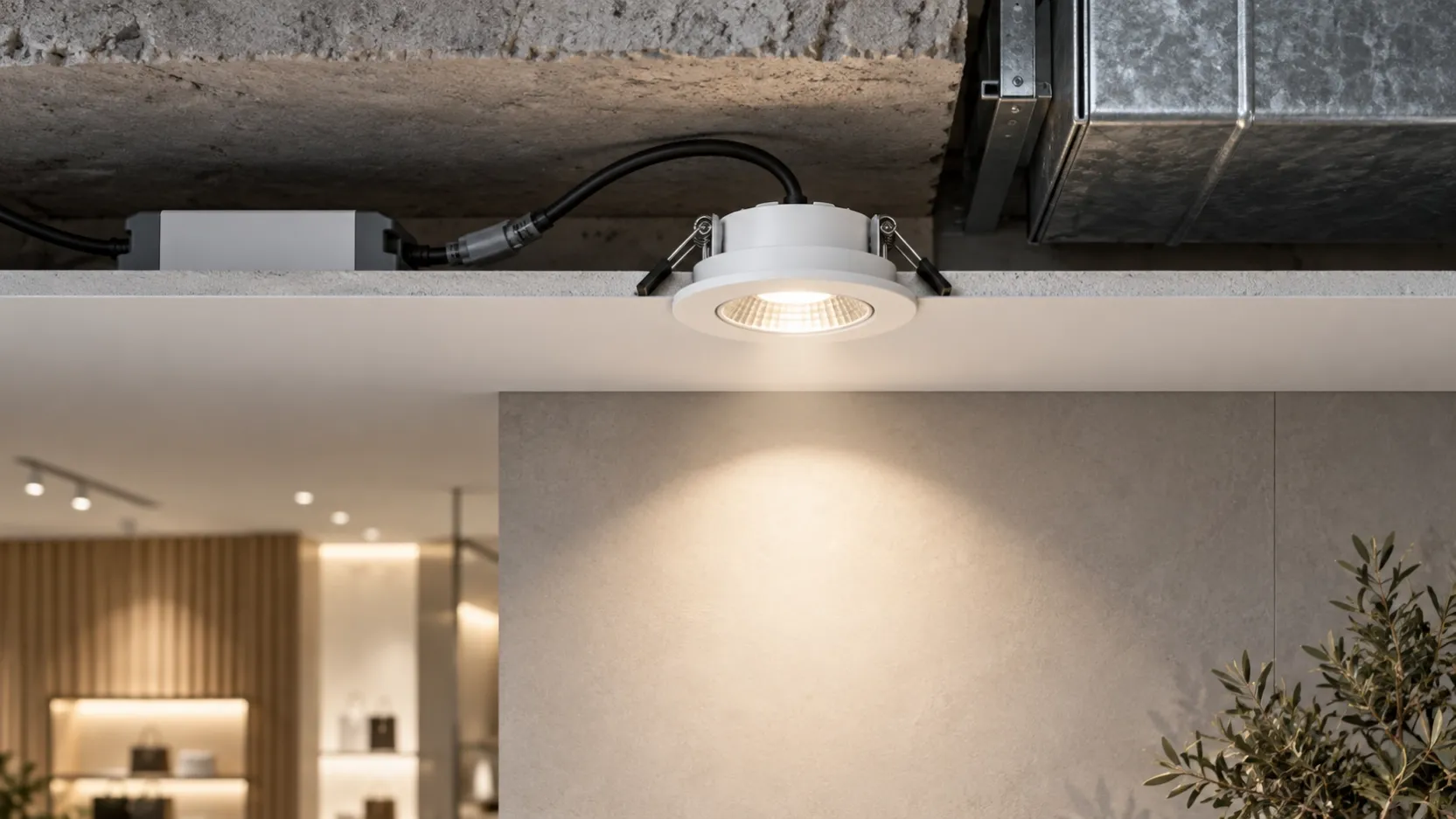
When the ceiling void is under 50 mm, the driver — not the LED — decides what fits. Most recessed COB spotlights are shallower than buyers assume, but their external drivers are not. The practical solution is a shallow fixture with a remote or integrated driver, and the void depth confirmed before the ceiling is closed.
Key facts about shallow ceiling voids
- 50 mm is the practical limit for most recessed spotlights with an external driver.
- The driver is usually the deepest component, not the light engine.
- Remote drivers move the depth problem into a cupboard or ceiling service void.
- Surface-mounted fixtures need no void at all.
- Cut-out and void depth must both be confirmed before ordering.
Why is the lamp body height not enough?
A datasheet often states the fixture depth, for example 45 mm. That number usually describes the light engine body. The driver — a separate box — may be another 25–40 mm deep, plus cable space and heat clearance.
| Component | Typical depth |
|---|---|
| COB light engine body | 25–55 mm |
| External driver | 25–45 mm |
| Cable loop and connector | 15–25 mm |
| Heat clearance | 10–20 mm |
A "40 mm spotlight" can therefore need 80–120 mm of usable void once the driver and clearances are included. This is why shallow-ceiling projects fail at installation rather than at specification.
What should be confirmed before ordering?
| Item | Why |
|---|---|
| Usable void depth | Measured between ceiling and structure, not nominal |
| Driver type | Integrated or remote |
| Driver dimensions | Often the limiting component |
| Cut-out diameter | Set by the ceiling opening |
| Trim diameter | Must cover the cut-out |
| Heat clearance | Prevents driver overheating in a tight void |
| Access for replacement | A shallow void makes driver changes harder |
What are the options for a shallow ceiling?
| Option | Void needed | Trade-off |
|---|---|---|
| Shallow recessed spotlight with remote driver | 40–60 mm | Driver must be located elsewhere |
| Surface-mounted cylinder or box | None | Visible body below the ceiling |
| Track or pendant | None | Changes the ceiling design |
| Very shallow integrated fixture | 25–40 mm | Limited output and beam options |
Why does heat matter more in a shallow void?
A shallow void has less air movement, so heat builds up around the driver. Drivers run hotter, and their lifetime shortens. In a tight ceiling, the driver's thermal design matters more than in an open void.
- Check the driver's rated ambient temperature.
- Avoid enclosing the driver in insulation.
- Leave the specified clearance above the fixture.
- Prefer a driver with thermal protection rather than one without.
What should you send to the supplier?
- Measured void depth, with the measurement method
- Cut-out diameter, existing or planned
- Ceiling material and thickness
- Required beam angle and wattage
- Whether a remote driver position is available
- Photos of the ceiling with a tape measure in frame
A photo with a tape measure removes most of the ambiguity and is faster than several emails.
Which spotlights suit shallow ceilings?
The commercial LED lighting range includes shallow recessed and surface-mounted options. Frequently specified:
- DB-SLDL1-R — round COB downlight, surface or pendant mount, when the void cannot take a recessed fixture.
- DB-DL10D — 7W–15W adjustable downlight for standard voids.
- DB-DL6A — 24° deep recessed pinhole spotlight where a deeper void is available.
Send the measured void depth and cut-out, and we will confirm which model physically fits.
Frequently asked questions
Can a recessed spotlight fit in a 50 mm void?
Sometimes, if the driver is remote and the fixture is shallow. Confirm the driver dimensions, not just the fixture body.
What is the shallowest recessed option?
Very shallow integrated fixtures exist at 25–40 mm, with limited output and beam options. Where output matters, a surface-mounted or track fixture is usually the better answer.
Can the driver go in a cupboard?
Yes, if the cable run and voltage drop allow it. Remote drivers are common in tight ceilings and make later replacement much easier.
Does a shallow void reduce the fixture's life?
It can, because heat builds up. Check the driver's ambient rating and leave the specified clearance.
Should I order a sample before cutting the ceiling?
Yes. Cut one test opening, confirm the fixture and driver fit, then proceed with the rest.