Is 3000K Right for Both Ambient and Reading Light in Hotel Bedside Fixtures?
Is 3000K suitable for both bedside ambience and reading? See what hotel buyers should check before approving the room sample and lighting specification.
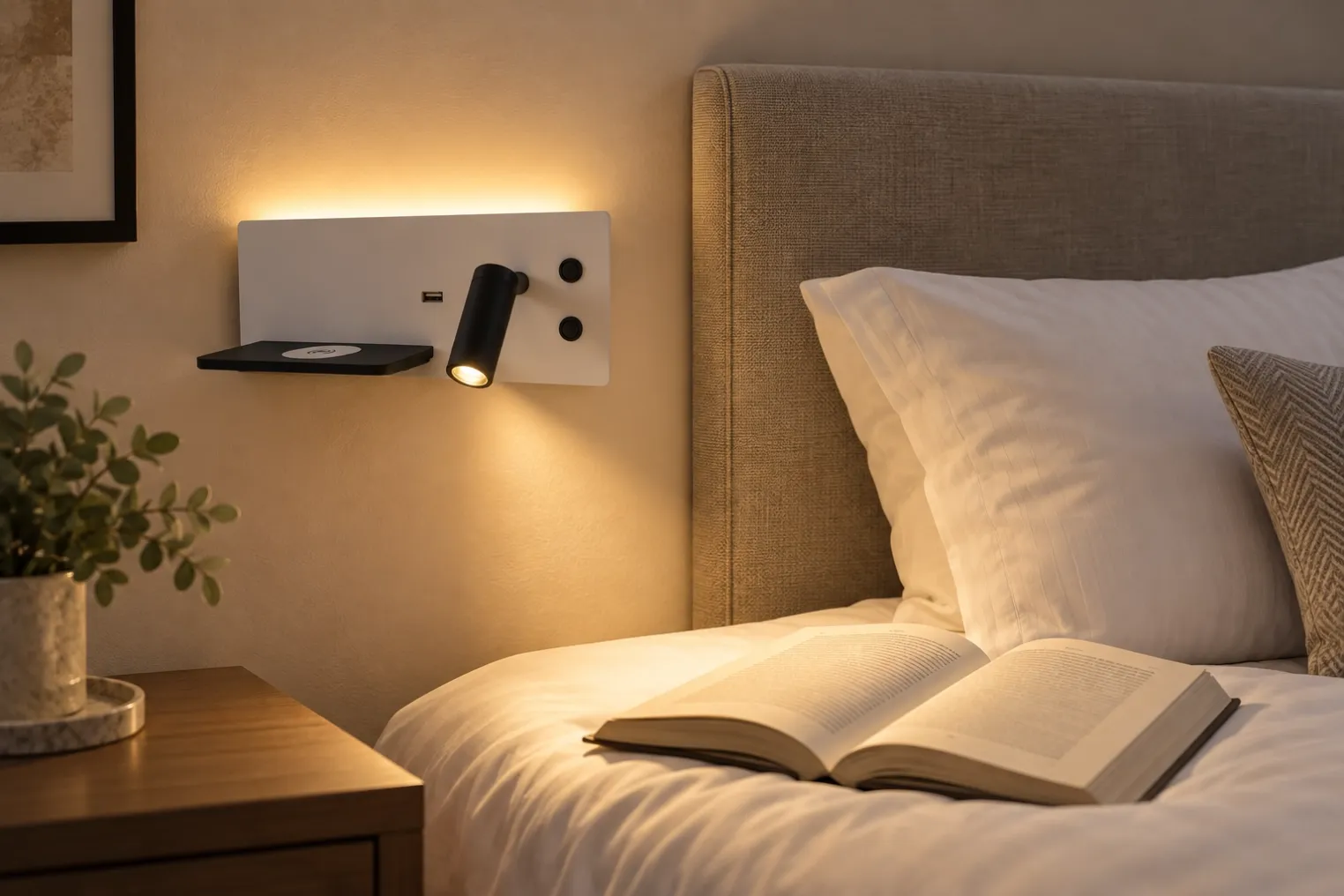
3000K works for both ambient and reading light in most hotel bedside fixtures — provided the reading spot has enough intensity. The ambient light can be soft and diffused; the reading light must deliver a usable level at the page. Same colour temperature, very different output requirement.
Key facts about 3000K in bedside fixtures
- 3000K reads warm but usable — the standard for hotel guest rooms.
- Ambient and reading need different intensities, not different CCTs.
- Reading needs 200–300 lux at the page, which a 2–3W spot can deliver at close range.
- 2700K suits relaxation but can feel dim for reading.
- Mixing CCTs within one fixture makes the unit look inconsistent.
Why use the same colour temperature?
A bedside unit is a single object on the wall. If the ambient glow is 2700K and the reading spot is 4000K, the fixture reads as two products assembled together rather than one designed object.
| Combination | Result |
|---|---|
| 2700K ambient + 2700K reading | Very warm; reading may feel dim |
| 3000K ambient + 3000K reading | Balanced; the usual hotel choice |
| 3000K ambient + 4000K reading | Visible mismatch; reads as a mistake |
| 2700K ambient + 3000K reading | Subtle; acceptable if the ambient is diffused |
Is 3000K bright enough for reading?
Colour temperature does not determine brightness. A 3W reading spot at 3000K can deliver 200–300 lux at a book held 40–60 cm away, which is comfortable for reading. The same fixture at 4000K would not be brighter — it would only look cooler.
| Requirement | Typical target |
|---|---|
| Reading light at the page | 200–300 lux |
| Ambient glow in the room | 50–100 lux |
| Reading spot beam | Narrow, 24–36° |
| Reading spot adjustability | Aimable to the seated reading position |
What matters is the beam angle and the distance to the page, not the CCT.
What should be checked in the mock-up room?
- Sit in the bed in the normal reading position and hold a book.
- Confirm the reading spot reaches the page without glare into the eyes.
- Check that the ambient light does not shine into the other guest's face.
- Test both lights at the lowest dim level.
- Confirm the CCT match between ambient and reading at a glance.
- Photograph with fixed white balance for the record.
Should every hotel choose 3000K?
Not every hotel. The choice follows the brand and the architecture:
| Hotel type | Typical CCT |
|---|---|
| Luxury and boutique | 2700K for a warmer feel |
| Business and midscale | 3000K for clarity |
| Resort | 2700–3000K depending on materials |
| Healthcare or care | 3000–4000K for task visibility |
Whatever the choice, the two functions inside one fixture should match.
Which bedside models use a single CCT?
The LED wall light range includes bedside models with matched ambient and reading CCT. Frequently specified:
- DB-LWLA08B — 7W ambient plus 3W adjustable reading, both 3000K, with 15W Qi charging.
- DB-LWL-A08A-R12W — round bedside light with dual switches.
- DB-LWL-A08A-S12W — square variant for mirrored layouts.
Minimum order is 10 pcs. Send the room count and the intended reading position, and we will confirm the wattage and beam that meet it.
Frequently asked questions
Is 2700K too warm for reading?
It can feel dim, but the perceived dimness comes from the output, not the CCT. A higher-output 2700K spot reads comfortably.
Can the reading light be a different CCT from the ambient?
It can be specified, but it usually reads as a mismatch on the wall. Keep them the same unless the design calls for contrast.
Does CCT affect sleep?
Cooler light suppresses melatonin more. Warm CCT is generally preferred in guest rooms for that reason.
What if the hotel wants 4000K for reading?
Use a separate reading fixture rather than mixing CCTs inside one unit. Then each fixture reads as intentional.
How is the CCT checked on a sample?
Compare ambient and reading at the same time against a white surface, then confirm against the approved sample.