Hotel Outdoor Lighting: 2700K vs 3000K vs 4000K
Compare 2700K, 3000K and 4000K for hotel entrances, pathways and landscapes. See which CCT suits stone, timber and planting.
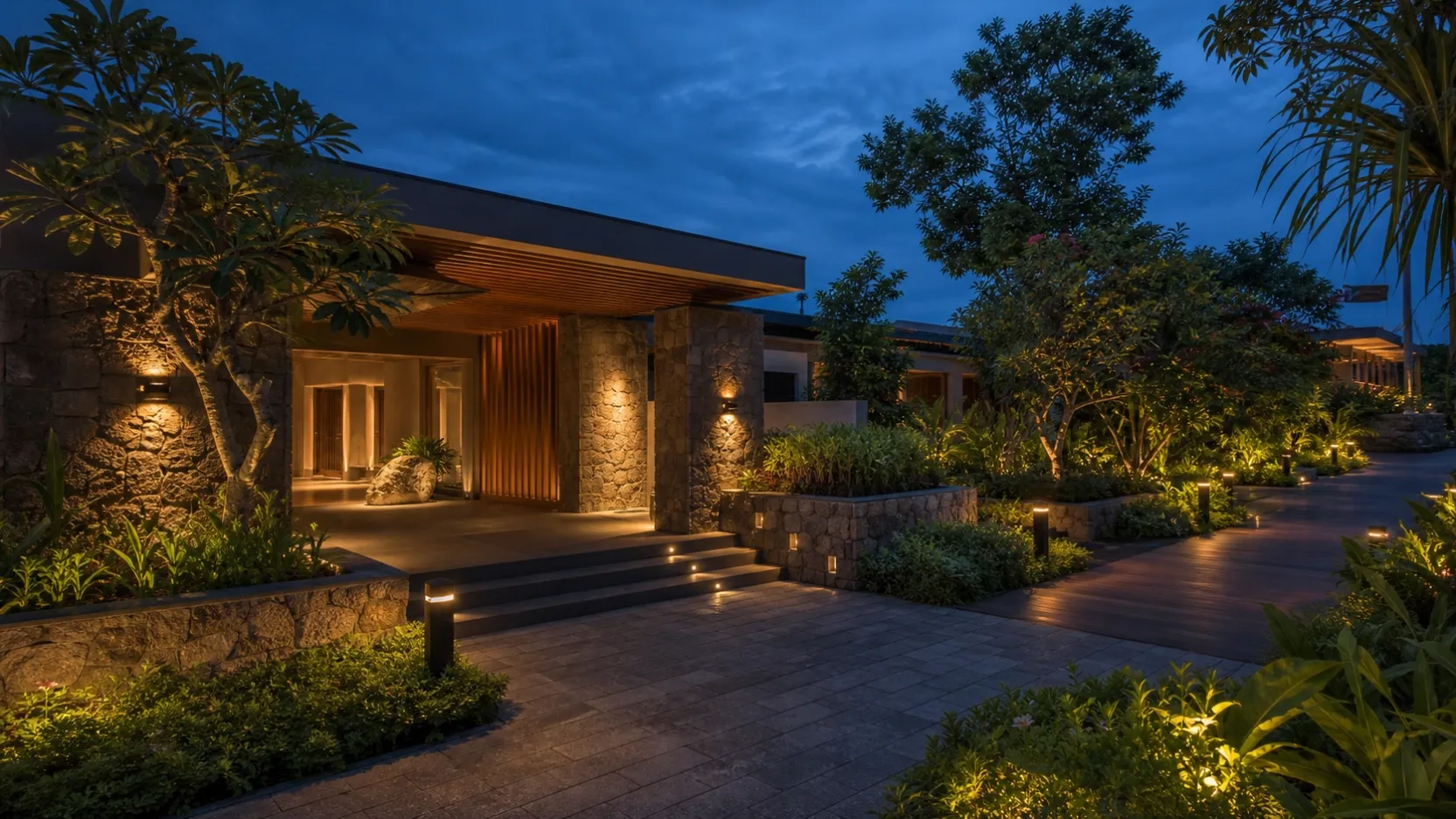
For most hotel entrances, pathways and gardens, 2700K to 3000K is the practical starting range. It creates a warm arrival experience and works well with stone, timber and planting. 4000K is sometimes justified for service areas, but it rarely flatters a guest-facing facade. The final choice should reflect the hotel's architecture, local lighting rules and the actual product specification.
Quick CCT decision guide
- 2700K — resort gardens, terraces, spa approaches, timber and warm stone.
- 3000K — main entrances, drop-off zones, walkways, mixed indoor and outdoor schemes.
- 3500K — transitional zones where exterior light meets a cooler crisp interior.
- 4000K — service yards, car park edges, security-focused areas. Avoid it on guest facades.
Should You Choose 2700K or 3000K?
Where does 2700K work well?
2700K gives terraces, garden paths and resort entrances a softer, more relaxed feel. It is particularly suitable when the design uses warm stone, wood or intimate landscape areas. On textured surfaces such as split-face stone or brick, the warmer tone also reduces the contrast that can make a facade look harsh at night.
When is 3000K more practical?
3000K still feels warm but can provide a slightly clearer appearance around main entrances, drop-off areas and busy walkways. It also coordinates easily with many indoor hospitality lighting schemes, which matters when a guest moves from the lobby to the porte-cochere in a few steps.
A useful rule: if the guest sees the interior and exterior together, match them within one step. Mixing a 2700K lobby with a 4000K entrance creates a visible colour break at the door.
Is 4000K Suitable for Hotel Exteriors?
4000K may suit selected contemporary facades or task-focused service areas, but it can feel cool beside warm interior lighting and natural materials. Review a sample on the actual wall or paving before approval.
In practice, 4000K is most defensible where the task is visibility rather than atmosphere: loading bays, service corridors, bin stores and back-of-house routes. On a guest-facing elevation it tends to flatten stone and drain the warmth from timber.
Should One Hotel Use Several Color Temperatures?
It is possible, but connected areas should feel intentional. Randomly mixing 2700K, 3000K and 4000K can make the project look inconsistent. Keep one main CCT across the guest route, then introduce another only where the function clearly changes.
A workable hierarchy is 2700K for gardens and terraces, 3000K for entrances and walkways, and 4000K restricted to back-of-house. That gives each zone a reason for its colour temperature rather than an accident.
DarkSky guidance and IES recommendations both favour warmer outdoor light at lower output where possible. Current DarkSky resort guidance uses 3000K or below as an eligibility requirement. This does not automatically make a project DarkSky Approved; distribution, output, shielding and controls must also be assessed.
What Else Changes the Result Besides CCT?
Colour rendering
Two fixtures at the same 3000K can look quite different if their colour rendering differs. For hotel exteriors, specify Ra above 80 as a minimum and look at R9 if red brick, timber or planting needs to read naturally. Low R9 makes warm materials look grey and flat.
Beam direction and glare
An up-and-down wall light throws light across the facade in two directions, which reads very differently from a single downward beam. On stone or concrete the beam pattern stays legible; on smooth painted walls a narrow beam can produce visible hot spots and scalloping.
Surface reflectance
Light limestone reflects far more than dark brick or weathered timber. Two walls lit by the same fixture at the same CCT will not appear equally bright. Approve samples on the actual substrate, not on a white board.
Brightness and adaptation
Human vision adapts to ambient light. A 2700K fixture at high output can read as cooler and harsher than the same CCT at a lower output. Specify delivered lumens and spacing rather than wattage alone.
How Should the CCT Be Tested Before Approval?
- Mount at least one sample at the real installation height and angle.
- View it at night, from the guest's approach direction, not from directly below.
- Compare against the adjacent interior lighting through the glass.
- Check the wall or paving surface in both wet and dry conditions.
- Photograph with a fixed white balance so later comparisons stay honest.
- Confirm the supplied CCT tolerance and binning, not just the nominal value.
What Should Buyers Confirm?
- Nominal CCT, binning and allowed tolerance
- Colour rendering index, including R9 where warm materials matter
- Beam direction, distribution and glare control
- Dimming protocol and driver compatibility
- IP rating and corrosion resistance for the local climate
- Local light pollution or planning requirements
- Consistency across every model in the same project
Send us your site plan, material palette and lighting schedule for a model-specific recommendation. Final CCT and performance should be confirmed through the relevant datasheet, sample and project review.
Which Fixture Types Suit Each Zone?
- Facades and entrances — LED wall lights with up-and-down or adjustable beams.
- Stairs and level changes — recessed or surface-mounted step lights.
- Garden paths and planting — bollards and garden lights.
Frequently Asked Questions
Is 3000K too yellow for a hotel entrance?
Usually not, but the result depends on the wall material, brightness and surrounding light. Test a sample on site.
Can 2700K and 3000K be used together?
Yes, when different zones have a clear purpose. Avoid mixing them randomly along one continuous guest route.
Does 3000K mean a fixture is DarkSky Approved?
No. CCT is only one requirement. Product design, light distribution, output and controls must also be evaluated.
Is 4000K ever acceptable outdoors at a hotel?
Yes, but usually only in back-of-house or security areas. On guest-facing facades it tends to look clinical and to flatten warm materials.
Does higher CCT mean brighter light?
No. Colour temperature and brightness are separate. A 2700K fixture and a 4000K fixture at the same lumen output deliver the same amount of light; they only differ in appearance.
What CCT should match a 3000K hotel interior?
Use 3000K outdoors as well, or step to 2700K if the exterior materials are warm and the transition should feel softer. Avoid jumping straight to 4000K.
Related reading
- How to position outdoor wall lights for hotel entrances and walkways
- What to check before approving outdoor LED wall light samples
- How to avoid flicker complaints in hotel projects
Featured fixtures for hotel exteriors
- DB-LWL-A06AIP65 adjustable beam LED wall light — IP65, independently adjustable up and down beams.
- DB-CPDA088 round LED bollard light — 7W IP65, 400 to 800mm heights.
- DB-LSL-01L90 recessed step light — 3W IP65 with optional PIR and interchangeable faceplates.