Up-and-Down or Single-Beam Wall Lights for Commercial Buildings
Compare up-and-down and single-beam LED wall lights by lighting task, facade surface and installation position. Send your drawing for model review.
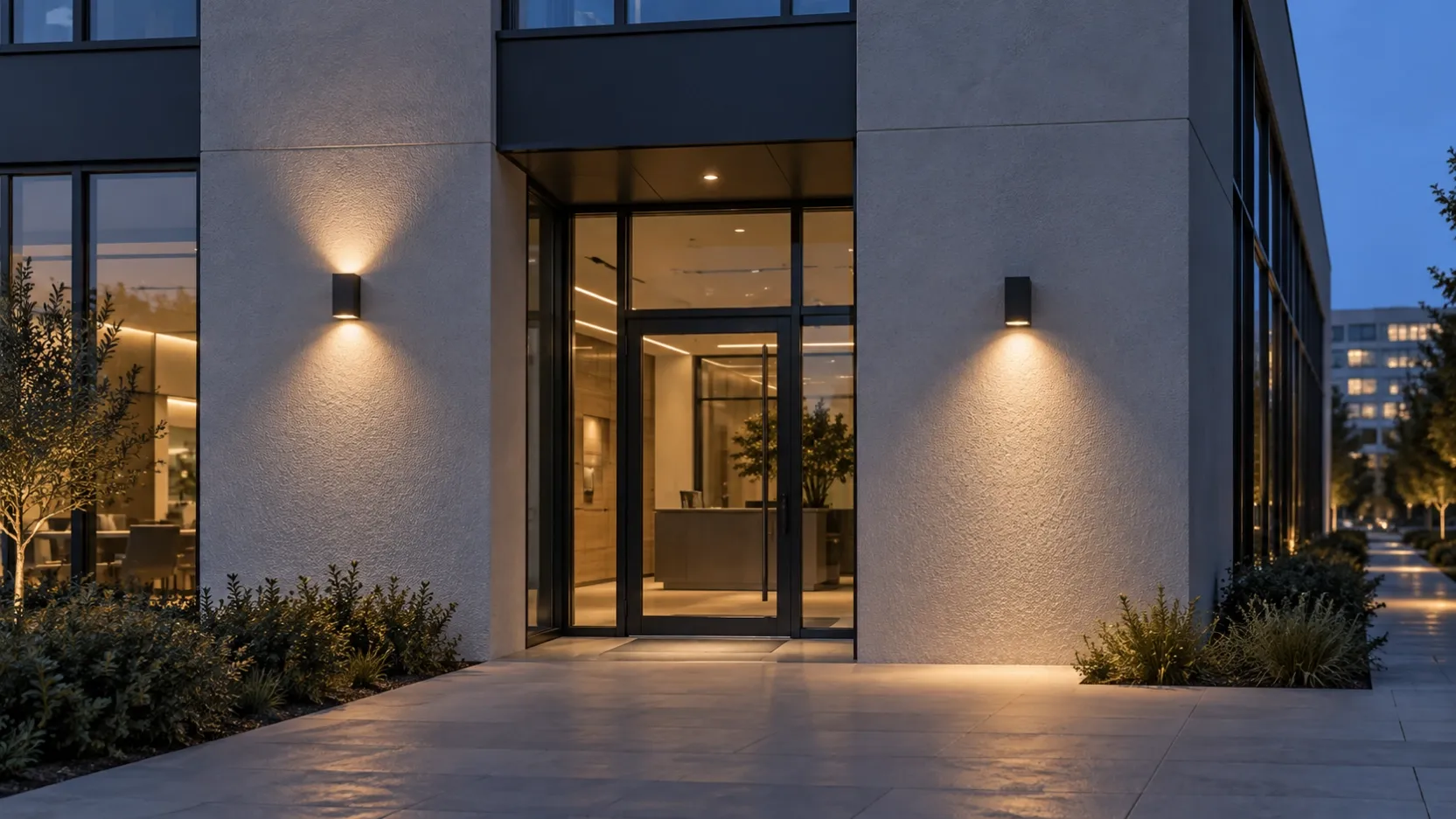
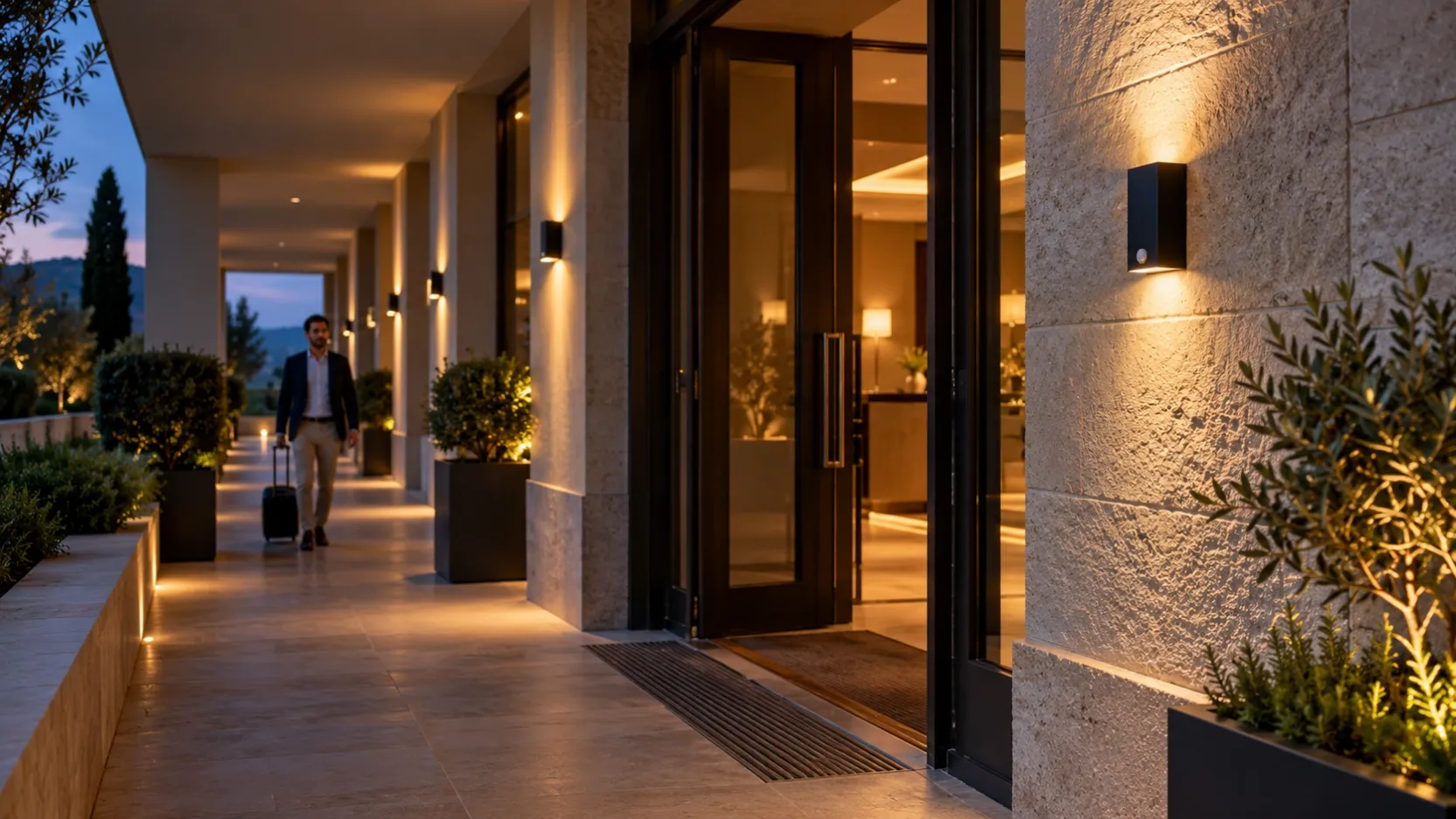
Up-and-down wall lights create a symmetrical facade rhythm; single-beam lights put light where it is needed without an upward component. Choose up-and-down for hotel elevations and villa facades where the pattern is part of the design. Choose single-beam for signage, entrances and any location where upward light is restricted or would spill onto neighbours.
Key facts about up-and-down vs single-beam wall lights
- Up-and-down produces two matched light cones, one above and one below the fixture.
- Single-beam sends light in one direction, usually downward.
- Light pollution rules in many markets restrict upward light — single-beam complies more easily.
- Pattern legibility depends on wall texture: stone and concrete hold a pattern, smooth paint shows hotspots.
- Spacing sets the rhythm: 1.5–3 m for a continuous wash, wider for individual accents.
What is the practical difference between the two?
| Property | Up-and-down | Single-beam |
|---|---|---|
| Light pattern | Two symmetrical cones | One directed cone |
| Facade rhythm | Strong, repeatable | Discrete accents |
| Upward light | Yes — may breach local rules | Minimal |
| Glare risk | Higher near eye level | Lower |
| Best for | Hotel and villa facades | Signage, entrances, corridors |
Which option fits each project area?
| Area | Recommended | Reason |
|---|---|---|
| Hotel main facade | Up-and-down | Continuous rhythm across a long elevation |
| Villa exterior | Up-and-down or adjustable | Balanced accent, adjustable for the wall surface |
| Entrance approach | Single-beam downward | Lights the walking surface without sky spill |
| Signage and logos | Single-beam aimed | Light the sign face, not the surroundings |
| Corridor walls | Single-beam or adjustable | Directed wash, less glare in a narrow space |
| Light-pollution zones | Single-beam only | Meets upward-light restrictions |
Why does the wall surface change the result?
The same fixture reads differently on different substrates. On split-face stone or brick, the texture scatters light and softens the pattern — the beam stays legible but loses definition. On smooth painted render, the pattern reads sharply and can show visible scalloping if fixtures are spaced too far apart.
On dark surfaces, less light reflects back, so the fixture appears dimmer than expected. On light limestone, the same output reads considerably brighter. This is why a sample on the actual wall matters more than a sample on a white board.
What should wholesalers compare on samples?
- Pattern symmetry between the upper and lower cone
- Visible source and glare at eye height
- Beam edge definition on the intended surface
- Colour consistency between units in the same batch
- Finish match across the models in the range
- Whether the fixture can be aimed after installation
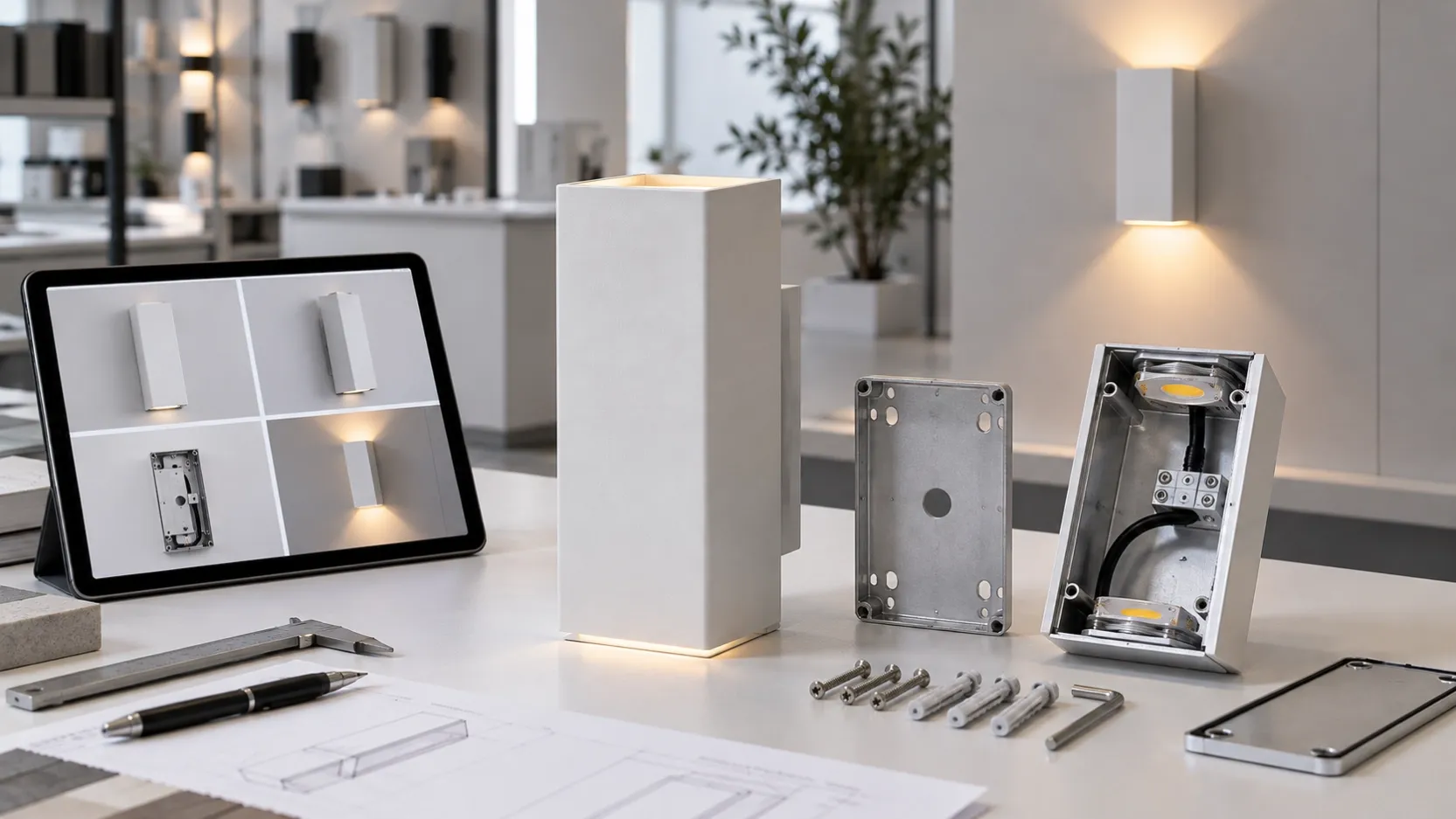
- Mounting plate fit against the wall detail
Which wall light should you request?
If the project needs a regular facade rhythm and upward light is permitted, choose a symmetrical up-and-down model. If the wall carries signage or the site restricts upward light, choose a single-beam or asymmetric model.
Where the design is not finalised, an adjustable model lets the installer set the pattern on site rather than committing at specification stage. That flexibility often removes the need for a separate variant.
Review the full LED wall light range before selecting. Frequently specified models:
- DB-LWL-A06AIP65 — 6W/12W IP65 with two heads adjustable 0–180°, covering both patterns in one fixture.
- DB-LWL-A03A — 6W/12W IP44 symmetrical up-and-down for covered facades and corridors.
- DB-LWL-A05A — 4W–12W IP65 multi-beam for decorative facade effects.
Send the wall elevation, mounting height and required night-time effect, and we will confirm the pattern that matches the project.
Frequently asked questions
Are up-and-down wall lights allowed in light-pollution zones?
Often restricted, because they send light upward. Check local planning rules; where upward light is limited, specify a single-beam or shielded model instead.
Do up-and-down lights look better on stone or painted walls?
Stone and brick soften the pattern and suit symmetrical up-and-down lighting. Smooth painted walls show the pattern sharply and reveal spacing errors.
Can one fixture switch between the two patterns?
Some adjustable models can. A fixture with independently rotating heads can be set to an up-and-down pattern or aimed to one side, which reduces the number of variants on a project.
How far apart should up-and-down wall lights be spaced?
Start at 1.5 to 3 m at a mounting height of 2.4 to 3.5 m. Closer spacing reads as a continuous wash; wider spacing reads as individual accents.
Does a single-beam light use less energy?
Not necessarily. Output depends on the LED and driver, not the pattern. A single-beam fixture at the same wattage simply directs its output one way.
Related reading
To integrate the building facade itself into the night-time lighting design, one might choose LED wall lights that cast light both upwards and downwards; conversely, if the priority is to illuminate entrances, walkways, or the area directly beneath the fixture, a model that directs light only downwards is preferable. Both options have their respective merits, and neither is inherently superior to the other. Before placing an order, commercial clients should comprehensively evaluate their lighting requirements, wall materials, installation locations, and the actual lighting performance of the samples.
What is the practical difference between the two?
What does an up-and-down wall light do?
It sends light in two directions, creating a vertical pattern above and below the fitting. This can define columns, repeated facade sections and entrance walls. The result is decorative, so spacing and alignment remain visible across the entire building.
What does a single-beam wall light do?
A single-beam model directs light mainly upward or downward. Downward versions are often considered when the area below the fitting needs attention. Upward versions may be used to highlight part of a facade, subject to the project’s lighting plan.
Which option fits each project area?
| Project area | Starting option | Check before ordering |
|---|---|---|
| Facade columns | Up-and-down beam | Spacing and beam appearance |
| Doorway | Downward single beam | Mounting height and glare |
| Walkway edge | Downward single beam | Coverage below the fitting |
| Feature wall | Either option | Wall texture and design intent |
Why does the wall surface change the result?
Rough stone breaks up the beam edge, while a smooth light-coloured wall can make the pattern appear clearer. Dark surfaces may produce a quieter visual effect. Ask for a sample and review it on a surface close to the project wall whenever the beam pattern is important.
What should wholesalers compare on samples?
Use the same wall, mounting height and viewing distance for each sample. Compare the beam direction, visible brightness, finish, mounting base and connection space. Record the exact model and electrical version instead of approving from a photo alone.
Which wall light should you request?
Browse our LED wall light range. Send us the facade drawing or site photo, installation height, wall material, quantity and preferred light effect. We can narrow the options before you arrange samples.
Frequently Asked Questions
Are up-and-down wall lights brighter than single-beam models?
Not necessarily. The visible result depends on the exact product, optics, wall surface and installation. Compare model-specific information and samples.
Can one wall-light model change between single and double beams?
Only if that exact model is designed with the relevant optical option. Do not assume the light direction can be changed after installation.
Which beam type is better for a building entrance?
A downward beam can support the area below the fitting, while an up-and-down beam adds a stronger facade pattern. The entrance design may use either or both for different tasks.
What should buyers send before requesting samples?
Send the application, wall photo or drawing, mounting height, voltage, finish, quantity and the beam effect you want to evaluate.
Reviewed by DAYBREAK Lighting Project Team | Updated: September 2026