Why Does the Same LED Wall Light Look Different on Stone, Concrete and Painted Facades?
See how wall texture and colour change an LED wall light’s visible beam. Send your facade photo and quantity before choosing project samples.
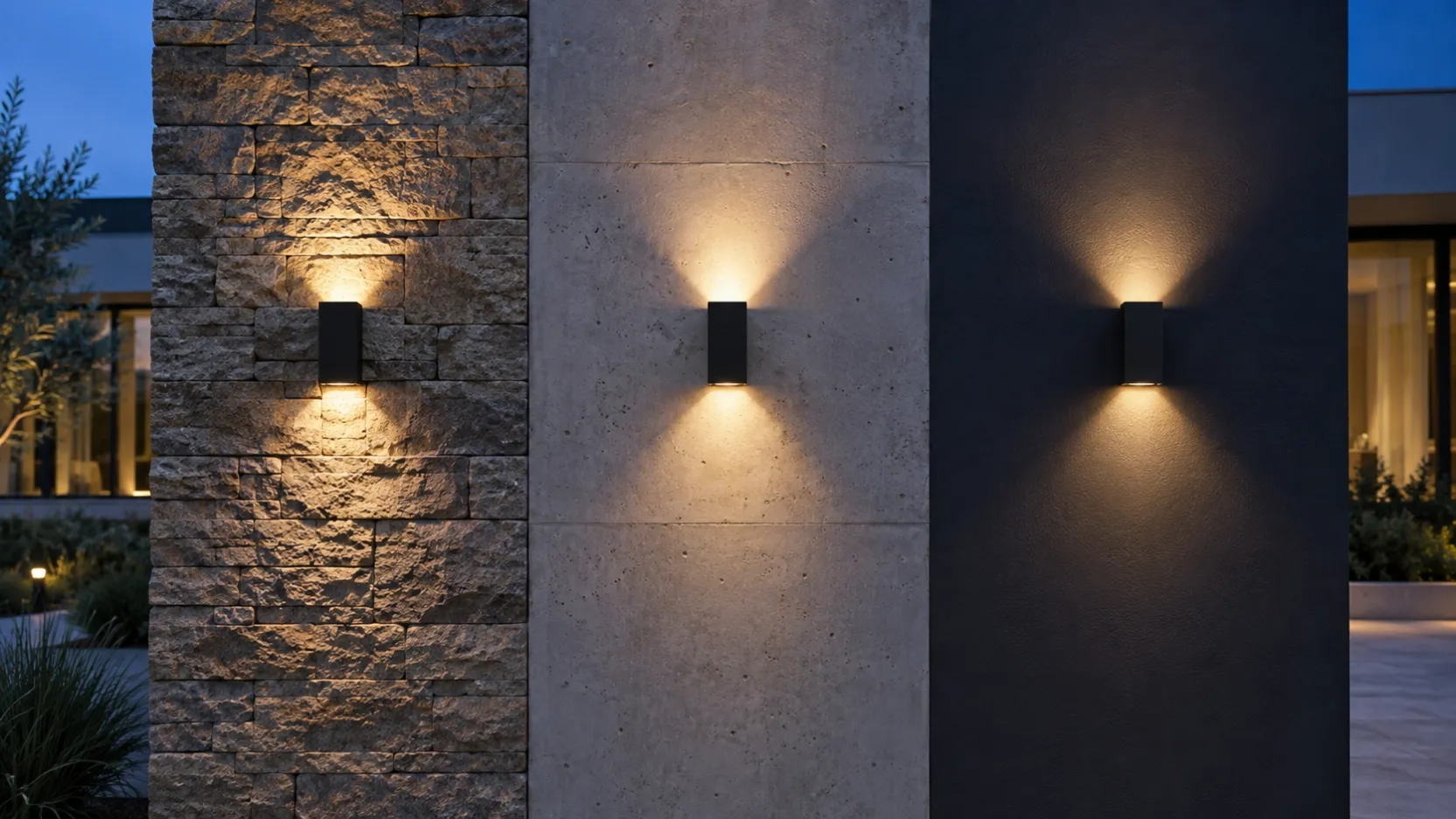
The same wall light looks different on stone, concrete and painted render because those surfaces reflect, scatter and absorb light differently. A fixture approved on a sample board can look wrong on the real wall — not because the fixture changed, but because the wall did.
Key facts about wall surface effects
- Reflectance sets apparent brightness — light limestone reads far brighter than dark brick.
- Texture scatters light — stone softens the beam, smooth paint shows the edge.
- Colour shifts perception — warm stone and cool render change how the CCT reads.
- Smooth surfaces reveal spacing errors — scalloping appears when beams are too far apart.
- Approve on the actual substrate, not a white board.
How can stone wall surfaces alter lighting effects?
Split-face stone or rough ashlar scatters light in many directions. The beam edge softens, the pattern loses definition, and the wall appears dimmer than a smooth surface at the same output.
| Stone type | Effect |
|---|---|
| Split-face or rough stone | Strong scatter; pattern softens; needs more output |
| Smooth stone or marble | Sharp pattern; hotspots possible |
| Light limestone | High reflectance; appears much brighter |
| Dark granite | Absorbs light; appears dimmer and cooler |
On rough stone, a narrow beam often disappears into the texture. A wider beam or higher output keeps the pattern legible.
What happens on smooth concrete?
Smooth concrete behaves almost like a painted surface for light distribution, but its colour and tone change the perceived CCT. Grey concrete reads cooler than the same fixture on warm stone.
- Pattern edges are sharp and clearly visible
- Hotspots appear if the beam is narrow and the fixture is close
- Scalloping between fixtures is obvious
- Darker concrete lowers apparent brightness
How does wall colour affect the result?
| Wall colour | Perceived effect |
|---|---|
| Warm cream or sandstone | Enhances 2700–3000K; feels warmer |
| Neutral grey | Reads cooler; 3000K can look like 3500K |
| White render | High reflectance; brightest apparent result |
| Dark charcoal | Absorbs light; pattern fades |
| Timber cladding | Warm grain; vertical lines can hide the beam edge |
This is why a sample approved on a white board can fail on site. The board reflects everything; the wall does not.
What should buyers check during sample approval?
- Mount the sample on the actual wall material, or a representative section.
- View from the guest's or pedestrian's direction.
- Check in daylight and at night with the fixture on.
- Compare with adjacent fixtures and materials.
- Photograph with fixed white balance and exposure.
- Confirm the spacing on the real wall, not on the drawing.
How should the specification change for each surface?
| Surface | Specification adjustment |
|---|---|
| Rough stone | Wider beam, higher output, sample on site |
| Smooth concrete | Wider spacing or wider beam to avoid scalloping |
| Painted render | Avoid narrow beams; check spacing carefully |
| Dark surface | Increase output; expect cooler perceived CCT |
| Reflective glass or metal | Check for glare and double images |
Which wall lights are specified across mixed facades?
The LED wall light range includes adjustable models that can be tuned per surface. Frequently specified where the facade uses several materials:
- DB-LWL-A06AIP65 — independently adjustable heads, so each surface can be aimed separately.
- DB-LWL-A07A — 6W multi-beam IP65 for decorative facade patterns.
- DB-LWL-A05A — 4W–12W multi-beam with contrast interior finish.
Send photos of each wall material and the mounting heights, and we will confirm which beam pattern holds up on each surface.
Frequently asked questions
Why does my wall light look dimmer on site than in the showroom?
Showrooms use light-coloured surfaces that reflect more light. Dark or textured walls absorb and scatter it, so the same fixture reads dimmer.
Does wall texture affect the CCT?
Not physically, but it changes perception. Warm stone makes 3000K read warmer; grey concrete makes it read cooler.
What causes scalloping between wall lights?
Narrow beams spaced too far apart on a smooth, light surface. Reduce spacing or widen the beam.
Should I increase wattage for a dark stone wall?
Often yes, or select a wider beam at the same wattage. Confirm on a sample rather than calculating from the datasheet.
Can one fixture work on both stone and render?
Yes, if it is adjustable. A fixed fixture may need a different beam angle on each surface.