Bulk LED Lighting Production: Pre-Order Checklist
Lock sample reference, driver, labels, packaging and documents before bulk LED production. A practical pre-production checklist for buyers.

Before approving bulk LED lighting production, buyers should lock the product model, electrical specifications, finish, labels, packaging and required documents in one final order sheet. The safest rule is simple: if a detail matters on arrival, confirm it in writing before production starts.
This guide turns that rule into a working pre-production checklist, with the items that most often cause disputes and the ones that are easiest to overlook.
Which product details should be locked first?
Should the purchase order refer to the approved sample?
Yes. Record the approved model, wattage, colour temperature, beam angle, body finish and driver option. If a physical sample was approved, give it a reference number or approval date so both sides are working from the same version.
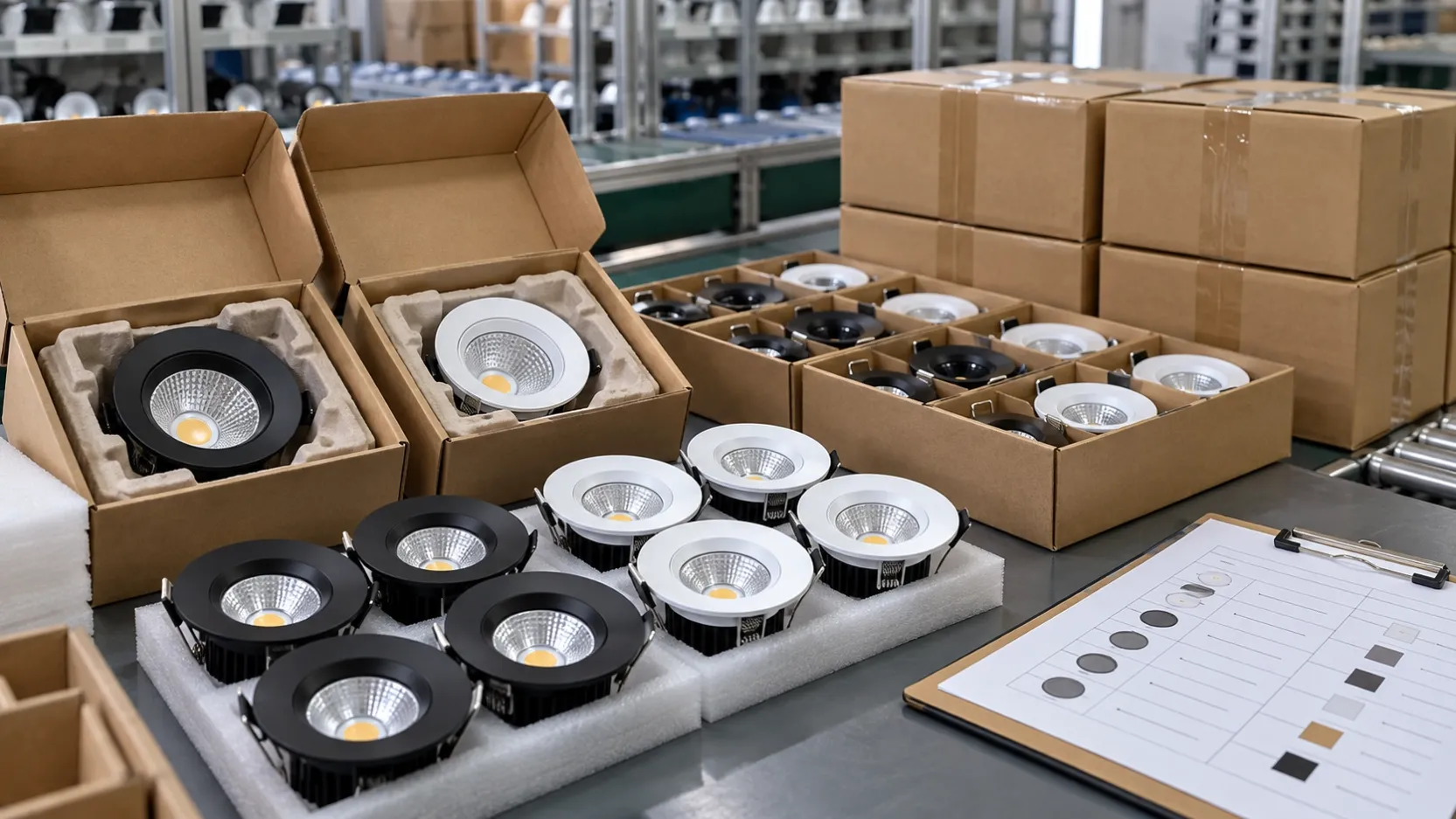
A useful practice is to keep the sample, photograph it under fixed lighting, and attach the photo set to the order sheet. A written specification with no reference photo leaves room for a reasonable but different interpretation of "black" or "3000K".
Which electrical details are often missed?
Confirm input voltage, frequency, dimming method and driver brand or specification where required. A fixture may look correct but still be unsuitable if the electrical configuration does not match the project.
The four that cause the most trouble:
- Voltage and frequency — 220–240V/50Hz for most export markets, but confirm 110–120V/60Hz where relevant.
- Dimming protocol — trailing edge, 0–10V, DALI or phase cut; these require different drivers.
- Driver brand and model — the same housing can hold a range of drivers with very different reliability.
- Flicker performance — specify whether flicker-free operation is required and at what dim level.
What should be confirmed beyond the fixture?
Do labels and packaging need approval?
Yes. Check product labels, carton marks, manuals, plug or cable requirements, carton quantity and protective packaging. These details affect customs clearance, warehouse handling and site delivery.
Specific items worth confirming in writing:
- Product label content: model, wattage, CCT, voltage, IP rating, batch code
- Barcode symbology and placement, if the buyer's warehouse scans cartons
- Master carton quantity, dimensions, gross weight and stack height
- Inner packaging: foam, bag, divider, and whether it survives courier handling
- Carton marks: buyer reference, destination port, country of origin
- Any private-label requirement, including logo position and print colour
Which documents should buyers request?
List the documents required for the specific model and destination market. Do not assume that one report covers every wattage, driver or product version. Ask the supplier to identify which documents match the ordered configuration.
| Document | What it covers | Common mistake |
|---|---|---|
| Test report (CE / LVD / EMC) | Electrical safety and EMC compliance | Report covers a different wattage or driver |
| RoHS declaration | Restricted substances | Declaration is generic, not model-specific |
| IP test report | Ingress protection claim | Report applies to a similar but different housing |
| Photometric / IES file | Light distribution data | File from a different optic or CCT |
| Packing list | Carton count, weights, dimensions | Does not match the actual shipment |
How can buyers prevent changes during production?
Use one signed pre-production sheet and record every later change by version. If the driver, finish, packaging or quantity changes, update the document and obtain confirmation before production continues.
A simple version discipline:
- Create one master order sheet with a version number and date.
- Attach the approved sample photos and any approved labels.
- Record every change as a new version, not as an email in a thread.
- Require written confirmation of the latest version before each production stage.
- Keep the final signed version with the shipping documents.
What should be checked during and after production?
Before the line starts
- Materials and components match the approved configuration
- Driver model on the production line matches the order sheet
- Labels and cartons are printed and approved
- The first unit is inspected against the approved sample
During production
- Aging test on a sample of units, not only the first one
- Colour consistency check across several units side by side
- IP-related assembly checks: gasket seating, gland tightness, screw torque
- Label and carton verification against the approved artwork
Before shipment
- Random inspection from the finished batch
- Carton drop or handling check on a sample carton
- Documentation complete and matched to the shipment
- Photo record of the packed pallet or container loading
What is the next step?
Send your fixture schedule, approved sample details and packaging requirements for a pre-production review. This short check helps reduce avoidable misunderstandings before the order reaches the production line.
If you are still selecting models, start from the LED wall lights, LED step lights, LED garden lights or commercial LED lighting range, then send the shortlist for a pre-production review.
Frequently asked questions
Can bulk production start before the final sample is approved?
It can, but the risk is higher. Approval should cover both appearance and the ordered electrical configuration.
Should packaging be included in the approval process?
Yes. Confirm carton structure, quantity per carton, labels and any project-specific marks before printing begins.
Do specifications remain the same across every LED lighting model?
No. Specifications, available options and supporting documents vary by model and configuration. Verify them against the exact product being ordered.
What is the most common cause of a production dispute?
A verbal or email-only change that never reached the order sheet. The factory produces to the last written version, so the written version must be the one everyone means.
Should the buyer inspect during production or only before shipment?
Both, where possible. A first-unit check before the line starts prevents a whole batch from being built to the wrong specification, and a pre-shipment check catches handling and packaging issues.