Matching White Finish and 3000K Across LED Wall Lights
Ordering several white 3000K wall lights? Learn what to compare before approving samples, then send us your model list for review.
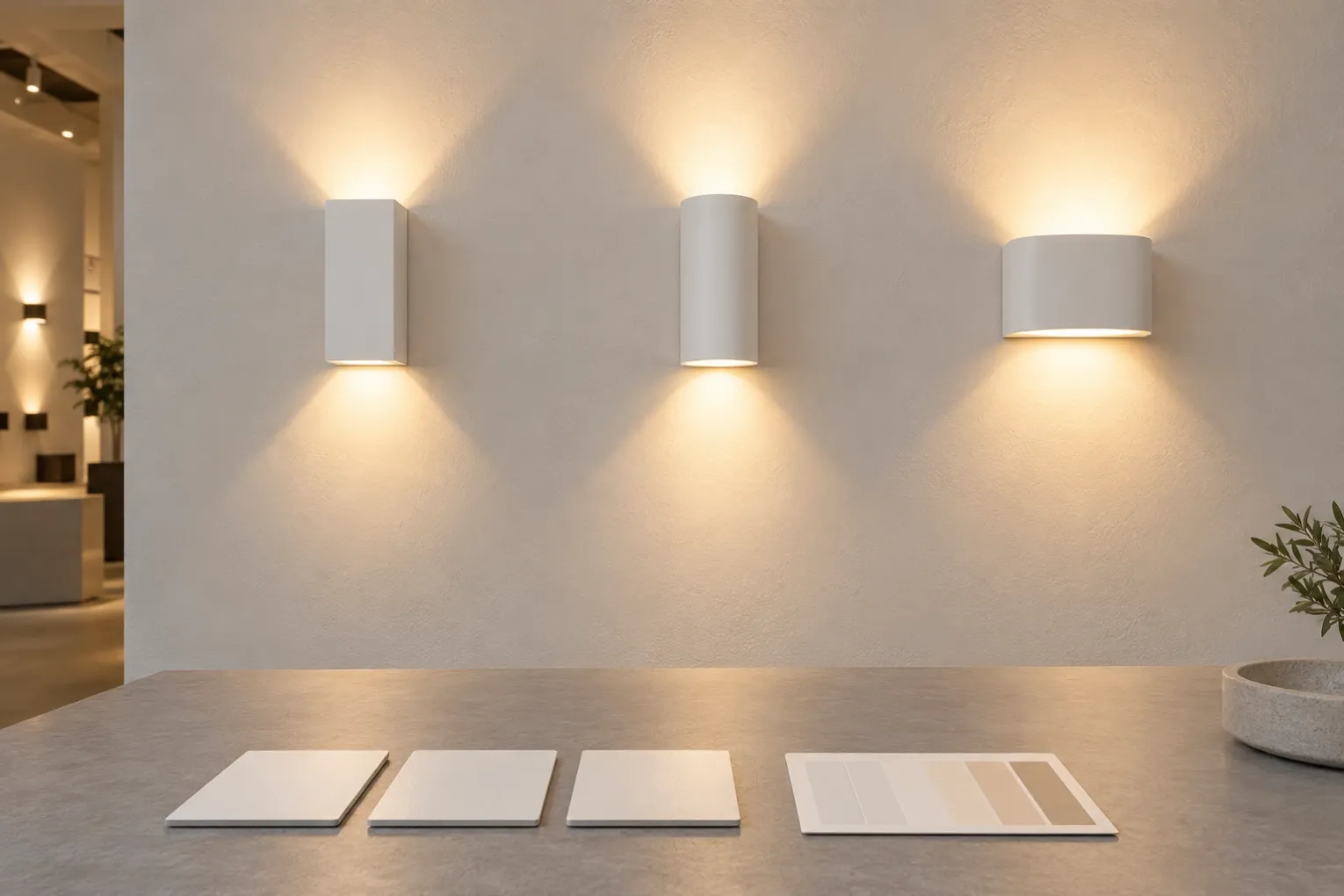
"White" is not one colour, and 3000K is not one shade. Across several wall light models, small differences in paint code, powder batch and LED binning become visible when the fixtures are mounted side by side. The fix is to approve one physical reference and carry the same finish code and CCT bin through the whole order.
Key facts about matching white finish and 3000K
- White has a code. RAL 9010, RAL 9016 and "standard white" are visibly different.
- Powder batches vary. The same code from two production runs can differ slightly in gloss and tone.
- 3000K has a bin range. Two 3000K fixtures can sit at opposite ends of the tolerance and read differently.
- Side-by-side is the test. Variation invisible in a single fixture becomes obvious in a row.
- One approval sample. A physical master beats any photo or datasheet.
Why can "white" look different?
| Source of variation | What it looks like |
|---|---|
| Different paint or powder code | One fixture warmer, one cooler |
| Different gloss level | One looks brighter even in the same colour |
| Different substrate | Aluminium vs steel body changes the final tone |
| Batching | Subtle shift between production runs |
| Lighting condition | Same white reads differently under warm and cool light |
In a hotel corridor with a row of wall lights, even a small shift is noticeable. The eye compares adjacent fixtures, not the fixture against a colour chip.
Does 3000K mean the lights will match?
No. A nominal 3000K part is supplied within a binning range, often measured in SDCM steps. Two fixtures at opposite ends of a three-step bin can look different when placed next to each other.
| Binning | Practical result |
|---|---|
| SDCM <3 | Visually consistent side by side — the usual specification for visible runs |
| SDCM <5 | Acceptable for separate rooms, noticeable in rows |
| SDCM <7 | Visible variation; not suitable for adjacent fixtures |
For a corridor, stair or facade run, specify SDCM <3 and ask for the same production batch across the order.
What should be approved?
- One physical master sample of the designated "white" finish.
- The finish code in writing — RAL number or a supplier-specific code, plus gloss level.
- One 3000K fixture as the CCT reference, with its binning stated.
- A photo set under fixed white balance — useful for later comparison, not as the primary reference.
- Written confirmation that bulk production uses the same finish code and LED batch.
How should the match be checked?
- Mount at least three units side by side, not one.
- View at the real installation distance, from the guest's direction.
- Check under the actual room lighting, not only under daylight.
- Compare in both daylight and at night with the fixture on.
- Photograph with a fixed white balance and the same exposure.
What should be specified in the order?
| Item | What to write |
|---|---|
| Finish | RAL or supplier code, gloss level, substrate |
| CCT | 3000K with binning tolerance (SDCM) |
| Batch | Single production batch for the visible run |
| Reference | Approved sample serial number and photo set |
| Spares | 2–5% from the same batch for later replacement |
Which models are commonly matched this way?
The LED wall light range can be supplied in a consistent white finish and a single 3000K batch across multiple models. Frequently matched options:
- DB-LWL-A10 — slim surface-mounted up/down wall light in three lengths.
- DB-LWL-A09-R — round rotatable wall light for corridors and feature walls.
- DB-LWL-A09-S — square variant of the same family, for a matched pair.
Frequently asked questions
Can two "white" wall lights from different suppliers match?
Only if both are specified with the same RAL code and gloss level. Even then, expect a small difference — approval of both samples side by side is the only reliable test.
Is 4000K easier to match than 3000K?
Not inherently. Binning tolerances apply at every CCT. Warm white simply makes small differences more visible against warm interior materials.
Do I need to replace every fixture if one is out of match?
Usually not. Replace the outlier from the same batch. This is why ordering spares from the production batch matters.
How long does a matched batch take?
Finished goods from a single batch are the practical route. Confirm the batch quantity and reserving spares when placing the order.